There is a particular kind of blindness that comes with over-preparation. A traveler arrives in a new city clutching a printed schedule — museum at ten, famous market at noon, rooftop bar at sunset — and moves through the place like a tourist completing a checklist rather than a person genuinely arriving somewhere. The city becomes a backdrop rather than a living thing. The local rhythms, the unhurried morning rituals, the way strangers greet each other at a neighborhood café — all of it passes unnoticed because the agenda has already decided what matters.
Spending the first 48 hours without a fixed itinerary is not the same as wandering aimlessly. It is a deliberate act of attention — a willingness to let the city reveal itself on its own terms rather than on a tourist board's curated highlights. The results, for those who try it, tend to be disorienting at first and quietly transformative by the end.
The Art of Arriving Without a Plan
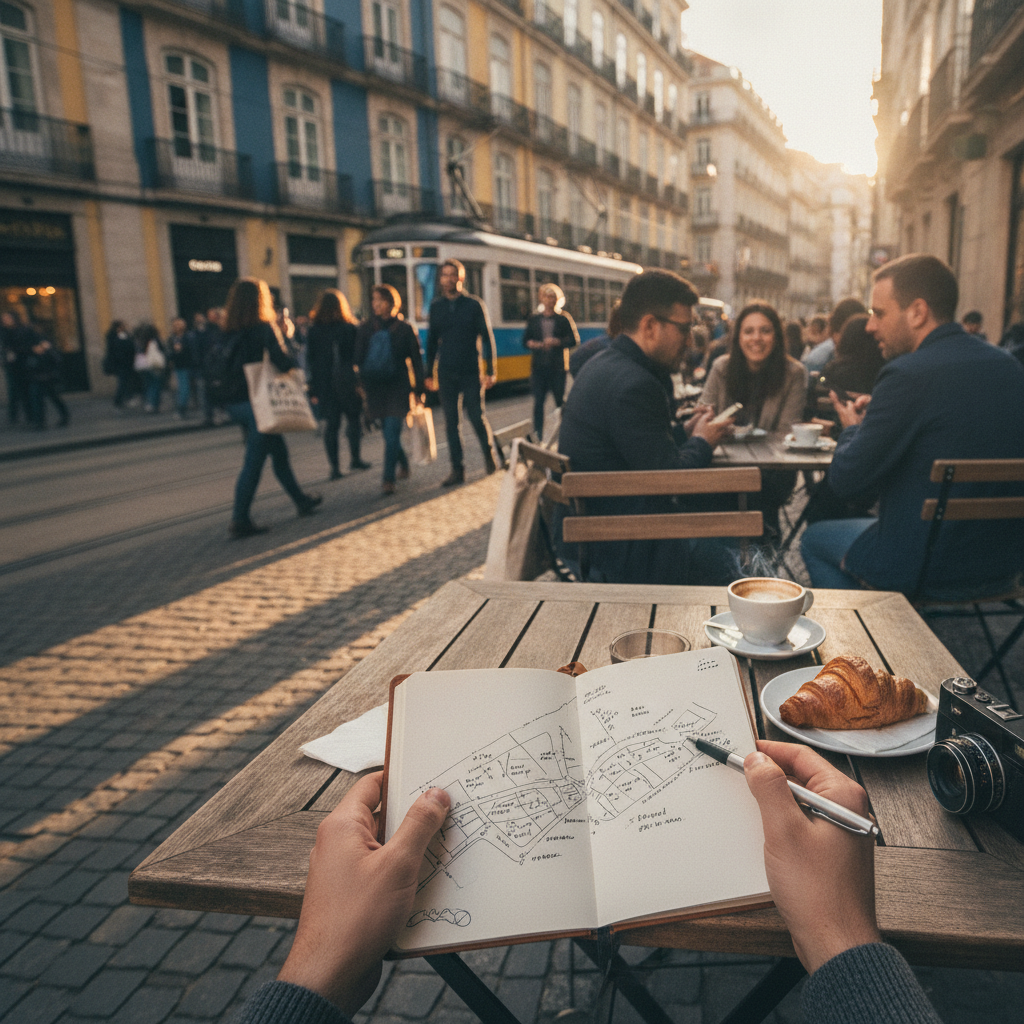
The instinct to fill a trip with scheduled activities comes from a reasonable place: no one wants to waste time or miss something important. But cities are not theme parks with a fixed number of attractions. They are organisms — shifting, layered, full of meaning that only becomes legible through slow, unhurried exposure. A traveler who books nothing for the first two days is not losing time; they are buying the currency of observation. In neighborhoods like Istanbul's Karaköy or Lisbon's Mouraria, the real texture of daily life — the fishmonger opening his stall, the elderly men playing backgammon in the afternoon shade — unfolds only for those who have nowhere else to be.
Following the Flâneur Tradition
The French have a useful word for this kind of purposeful wandering: *flâneur*, originally used to describe a person who strolls through urban life as a detached but deeply curious observer. The flâneur is not lost; they are paying a specific kind of attention — to architecture, to human behavior, to the small collisions between tradition and modernity that define a city's character. Adopting this posture for the first 48 hours means resisting the pull of the phone's map and instead choosing a direction, walking it, and noticing what appears. A side street in Mexico City's Roma Norte or a covered passage in Bologna can hold more cultural information than three hours in a well-reviewed gallery.
Reading the Morning as a Cultural Text
Mornings are where a city's true personality lives. The way residents begin their day — what they eat, where they gather, how fast or slow they move — encodes centuries of cultural habit. In Japan, the morning tea ceremony at a neighborhood *kissaten* (a traditional coffee shop, distinct from modern chains) follows an almost ritualistic quiet. In Naples, the *cornetto e caffè* — a flaky pastry and a standing espresso — is consumed at a bar counter in under five minutes, loud and social and completely unhurried in spirit despite its speed. Observing these rituals without interrupting them, simply by sitting nearby and ordering what the regulars order, communicates more about a place than any guidebook summary.
The Value of Getting Deliberately Lost
Being geographically uncertain in a new city is one of travel's most underrated tools. Not dangerously lost — but loose enough that the next turn is genuinely unknown. This is when serendipitous discoveries tend to happen: a courtyard tucked behind an unmarked gate in Marrakech's medina, a canal path in Amsterdam that leads away from the tourist circuit into a genuinely residential quarter. The experience also builds a mental map of the city that is far more detailed and personal than anything Google Maps can generate. The traveler remembers the smells, the sounds, the quality of light at a particular intersection — and those sensory anchors make the place feel real in a way that coordinates never can.
Letting Locals Set the Pace
One of the most reliable ways to read a city accurately is to observe how its residents use time — and then, gently, to sync with it. In cities where the *siesta* still holds (parts of Spain, southern Italy, Greece), the early afternoon is not dead time; it is structured rest, a cultural value embedded in the architecture of the day. Trying to do anything ambitious during those hours marks a traveler immediately as someone from outside the rhythm. Equally, in cities like Seoul or Taipei, the late evening comes alive in ways that have no Western equivalent — entire food markets, social scenes, and commercial districts that only open after dark. Paying attention to these temporal patterns, rather than imposing a home-country schedule onto them, is the difference between visiting a city and briefly inhabiting it.
Making the Unplanned Hours Count
By the time 48 hours have passed without an agenda, something has usually shifted. The city that felt opaque and slightly overwhelming on arrival has begun to acquire legibility — not the legibility of facts and dates, but the softer kind that comes from repeated, aimless exposure. You know, now, which streets feel residential and which feel performative. You have a neighborhood that already feels like yours, a café where the staff recognized you on the second visit, a corner where something small and unrepeatable happened that could only have happened there. The guidebook itinerary, when you finally consult it, looks different too — less like a syllabus and more like a set of suggestions to weigh against what you've already discovered on your own terms.
There is a particular kind of blindness that comes with over-preparation — and its antidote is not better research but more patience. The traveler who arrives ready to be surprised, who treats the first two days as an education rather than a performance, tends to leave with something more durable than photographs: a genuine sense of having been somewhere, of having let a place land. That quality of presence is what separates a trip remembered in full from one recalled only in highlight reels.