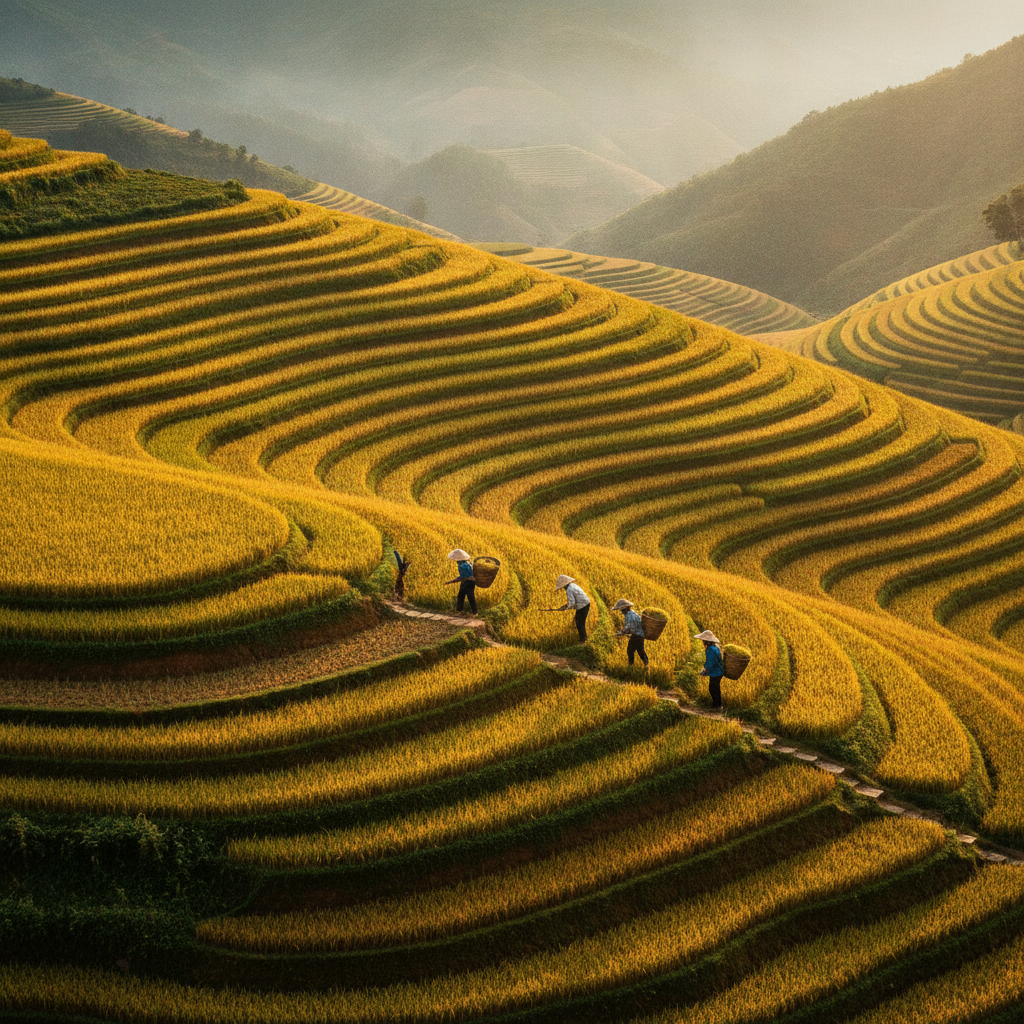
Few travel experiences in Southeast Asia rival the sight of Northern Vietnam's rice terraces during harvest season — golden fields cascading down hillsides, farmers in conical hats moving through waist-high stalks, and mountain air carrying the faint sweetness of ripening grain. If you time your two weeks well, you can move through this region at the exact moment when the colors peak and the tour buses haven't yet caught on.
Timing Your Arrival Around the Golden Window
The harvest season in Northern Vietnam typically falls between late September and early November, with the most intense golden color appearing in the Hoàng Su Phì and Mù Cang Chải districts during mid-October. The precise timing shifts slightly from year to year depending on rainfall patterns, so checking in with a local guesthouse a week before departure can save you from arriving a week too early or too late. Most years, the terraces in Mù Cang Chải hit peak color between the 5th and 20th of October. Arriving in the last week of September gives you a comfortable buffer to adjust.
Starting Point: Hanoi and the Road North
Your two weeks work best when you use Hanoi as your base for the first couple of nights rather than a full stop. The city gives you time to rest, gather supplies, and sort onward transport without losing momentum. From Hanoi, most travelers head northwest toward Nghĩa Lộ and then Mù Cang Chải — a route that takes roughly seven to eight hours by bus or private car. Booking through a reputable local operator like Sapa O'Chau or using the **12Go Asia** platform for bus comparisons helps you avoid the overpriced tourist shuttles that run on slower roads.
Getting the Logistics Right Early
One practical move is to book your guesthouse in Mù Cang Chải at least two weeks in advance, especially for the second and third weeks of October. Local homestays fill faster than most travelers expect, and staying in a family-run house rather than a tourist lodge puts you in better position to learn about which specific fields are ready. The **Booking.com** app works reasonably well here, though cross-referencing with local Facebook groups for northern Vietnam travelers often surfaces options that don't appear on the major platforms.
Days One Through Four: Mù Cang Chải and Its Surrounding Terraces
Spend your first four days based in Mù Cang Chải, using each morning for field walks before the midday heat settles in. The terraces around La Pán Tẩn and Chế Cu Nha are consistently the most photogenic, with steep gradients that catch the early light beautifully. Renting a motorbike from your guesthouse for around a half-day allows you to reach viewpoints that the day-trip crowds rarely find. Early morning departures — think 5:30 to 6:00 AM — put you on the terraces while mist still sits in the lower valleys, and you'll likely have entire sections to yourself.
Connecting With the H'Mông Communities
The villages surrounding Mù Cang Chải are predominantly H'Mông, and spending time in the markets rather than just passing through adds real depth to each day. The Sunday market in the town center draws farmers from surrounding hillsides selling produce, textiles, and livestock — arriving early means seeing the working version of it rather than the version that caters to cameras. Purchasing directly from vendors, even small items, is always appreciated and tends to open up brief but genuine exchanges.
Days Five Through Eight: Moving Into Hoàng Su Phì
After Mù Cang Chải, shifting northeast to Hoàng Su Phì offers a slightly different visual character — the terraces here are broader and more layered, with a different ethnic community, the Dao and Nùng peoples, working the fields. The journey between the two areas takes most of a day and is best done with your own rental transport or a hired driver rather than public buses, which rarely run direct routes. Hoàng Su Phì is quieter than Mù Cang Chải even at peak season, meaning you'll encounter fewer organized tour groups at the main viewpoints. Give yourself at least three full days here to walk the ridge paths between villages without rushing.
Navigating Without Data
Cell coverage in these districts is inconsistent, so downloading offline maps through **Maps.me** before leaving Hanoi makes a significant difference when you're on a motorbike between villages. The app includes many of the smaller trails and farm roads that Google Maps misses entirely, and the offline function works reliably even in areas with zero signal. Carrying a small portable power bank is worth the extra weight given how heavily you'll rely on your phone for navigation.
Days Nine Through Eleven: Sapa as a Transition Hub
Sapa tends to divide travelers — it's busier and more developed than the two districts you've just come from, but it serves a useful purpose in a two-week structure. Use it as a transition point rather than a destination, spending two nights to restock supplies, do laundry, and take a proper rest day before the final stretch. The town sits at a higher elevation and gets noticeably cooler in October, so this is a good moment to assess your layers and pick up anything you're missing before heading onward.
Days Twelve Through Fourteen: Bắc Hà and the Final Wind-Down
Bắc Hà, roughly two hours northeast of Sapa, holds what many consider the most authentic remaining Sunday market in Northern Vietnam — a weekly gathering that draws Flower H'Mông women in brilliantly embroidered clothing alongside traders from a dozen surrounding villages. Timing your arrival for a Saturday gives you a quieter day to settle in before the market, then a full Sunday to explore it at a relaxed pace. Your final night back in Hanoi works well as a buffer before your departure, giving you time to rest and process everything you've seen across two genuinely full weeks.
Tracking the Experience as You Go
Keeping a light travel journal — either physical or through an app like **Day One** — during a trip this visually rich helps you remember the specific details that photographs don't capture: the smell of rice drying in the sun, the sound of a water buffalo moving through a lower field at dawn. These notes become the part of the trip you'll return to most.
Northern Vietnam during harvest season rewards travelers who plan just enough to be in the right place at the right time, then stay flexible enough to follow the light wherever it leads. Start looking at late September or early October availability now, book your first few nights in Mù Cang Chải, and let the rest of the itinerary breathe. The terraces will be waiting.