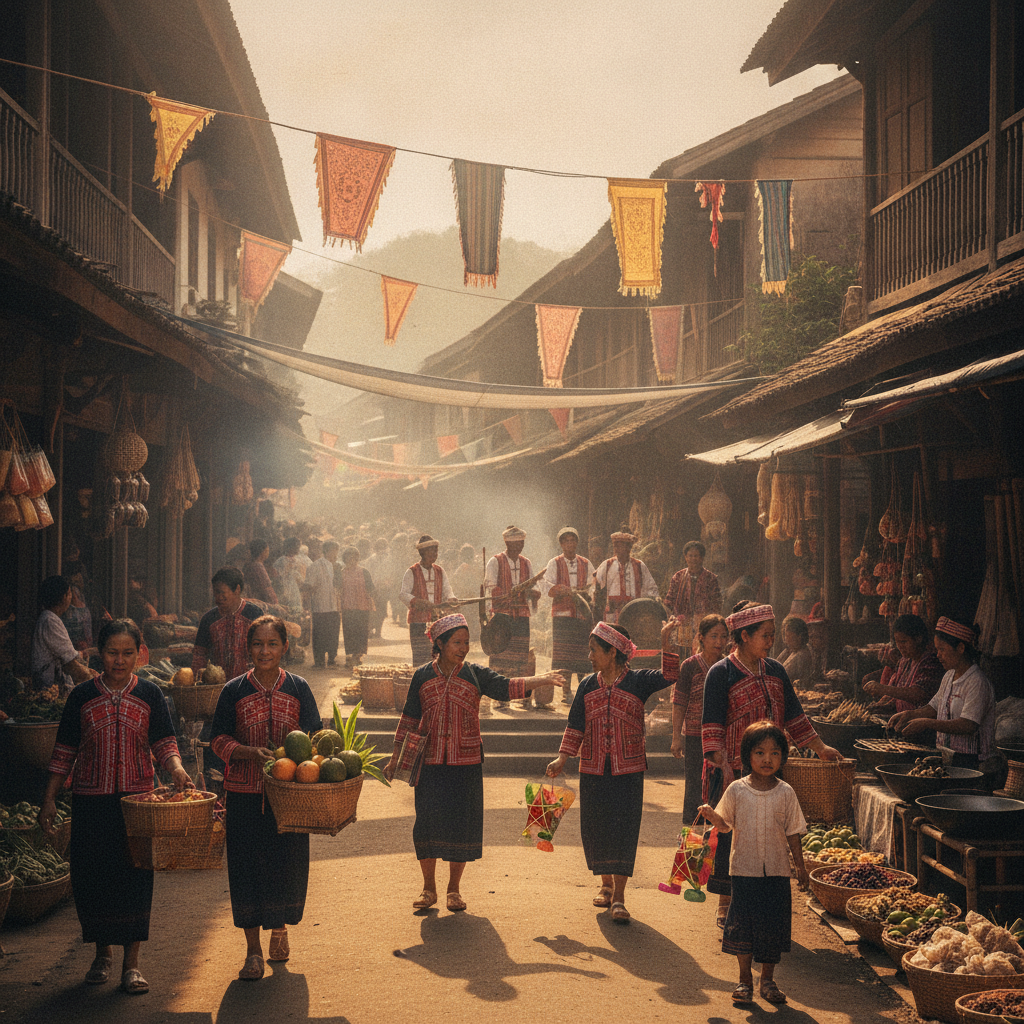
There is a particular kind of stillness that settles over a country in the days just after its most celebrated holiday. The banners are still hanging, the streets carry the faint perfume of incense or street food or marigold garlands, and the people — no longer performing for crowds or tourist cameras — return to something more like themselves. It is in this quieter aftermath, or in the run-up to a lesser-known regional festival, that a traveler begins to understand a culture not as a spectacle but as a living, breathing arrangement of values, rituals, and daily meaning.
The Difference Between Celebration and Performance
Every culture has its flagship holidays — the ones that appear on international travel calendars and generate the kind of foot traffic that strains infrastructure and inflates accommodation prices across entire regions. Diwali in Jaipur, Carnival in Rio, Lunar New Year in Bangkok: these are extraordinary events, rich with genuine tradition, but they have also become curated experiences shaped in part by the expectations of millions of outside visitors. What gets lost in that translation is subtle but significant. The rituals continue, the lights still dazzle, the music still moves — yet something of the interior life of the culture retreats slightly, as if standing back to let the performance proceed. Secondary festivals, by contrast, have not been packaged for export. They belong more fully to the people who observe them, and that belonging is precisely what makes them worth seeking out.
In Morocco, for instance, the Moussem of Tan-Tan — a gathering of Saharan and semi-nomadic peoples in the country's south — draws far fewer international visitors than the well-photographed medinas of Marrakech during Eid al-Fitr. Yet the Moussem, recognized by UNESCO for its intangible cultural heritage, offers something rarer: unscripted communion between communities, traditional dress worn out of pride rather than demonstration, and music that has not been softened for unfamiliar ears. Travelers who time their visit around events like this return with stories that feel genuinely earned rather than efficiently collected.
Rhythm, Ritual, and Regional Identity
Secondary festivals also reveal the profound regional variation that peak holidays tend to flatten. A country is rarely one culture; it is many cultures organized beneath a shared administrative identity. Japan offers a useful illustration. The country's major national holidays — Golden Week, Obon — pull enormous domestic and international crowds to the same handful of destinations. But Japan's regional matsuri calendar, which runs through every month of the year, tells a far more differentiated story. The Nebuta Matsuri in Aomori, with its towering illuminated floats and drumming that seems to come from somewhere beneath the ground, is a northern expression of identity that has little in common aesthetically or temperamentally with the refined elegance of Kyoto's Gion Matsuri. Both are real. Both are Japan. But only one of them is likely to be crowded beyond comfort, and only one of them feels like something that still belongs primarily to the people who built it.
This regional specificity is the grain of the culture — the texture that careful travelers seek and hurried ones miss entirely. When a traveler arrives in Oaxaca, Mexico, outside of the internationally celebrated Día de los Muertos season, they discover that the city's relationship with its indigenous Zapotec heritage is not a seasonal performance but a constant presence. The Guelaguetza festival, held in July, brings together communities from the surrounding valleys in an exchange of regional dances and offerings that is genuinely participatory. Tickets exist, but so does the surrounding atmosphere of preparation, the family meals, the costume-making, the conversations in Zapotec languages that drift through the markets. These are the details that reveal how a culture understands itself when it is not explaining itself to anyone.
What Travelers Gain by Shifting Their Timing
Beyond the cultural richness, the practical advantages of secondary festival travel are considerable and interconnected. Accommodation in cities like Oaxaca, Aomori, or Morocco's Souss-Massa region runs noticeably lower outside peak holiday windows. Local restaurants, guesthouses, and guides — the kind run by families rather than international hospitality chains — have more time and more genuine interest in the conversation. Queues at significant cultural sites are shorter or nonexistent. The traveler moves through the destination at a pace that allows for the kind of accidental discovery — a neighborhood shrine festival, a market that only assembles on a particular day of the lunar calendar, a craftsperson whose workshop door is open because there is no crowd outside — that structured peak-season tourism systematically eliminates.
Apps like Google Trips and regional cultural tourism boards, including those maintained by Japan's prefectural governments or Mexico's SECTUR system, now offer surprisingly detailed secondary festival calendars that were once difficult to access without local knowledge. The information infrastructure for this kind of travel has matured considerably, making it more accessible to travelers who are willing to do slightly more planning in exchange for a considerably richer return.
Finding Your Own Festival Season
If you are willing to reframe how you approach trip planning, the secondary festival calendar becomes one of the most useful tools available. Rather than choosing a destination and then checking what major events coincide with your travel dates, consider reversing the sequence entirely — identify a regional festival that genuinely interests you and build the itinerary around it. Look for events described with terms like *matsuri* (Japan's traditional local festivals), *moussem* (Morocco's tribal and saint's day gatherings), or *feria* (Spain's regional fairs, distinct from the internationally promoted Feria de Abril in Seville). Each of these terms points toward something that exists primarily for the community that created it, and that orientation — inward rather than outward — is what gives secondary festivals their particular and irreplaceable quality.
The traveler who arrives at a destination during its quieter, secondary festival season comes away with something that the peak-season itinerary rarely delivers: the sense that they have been somewhere, not just passed through it. The banners still hanging, the music still present in the air, the warmth of people who are celebrating for themselves and simply happy to share the occasion — this is the version of travel that tends to stay with a person long after the photographs have been sorted and the suitcase has been unpacked.