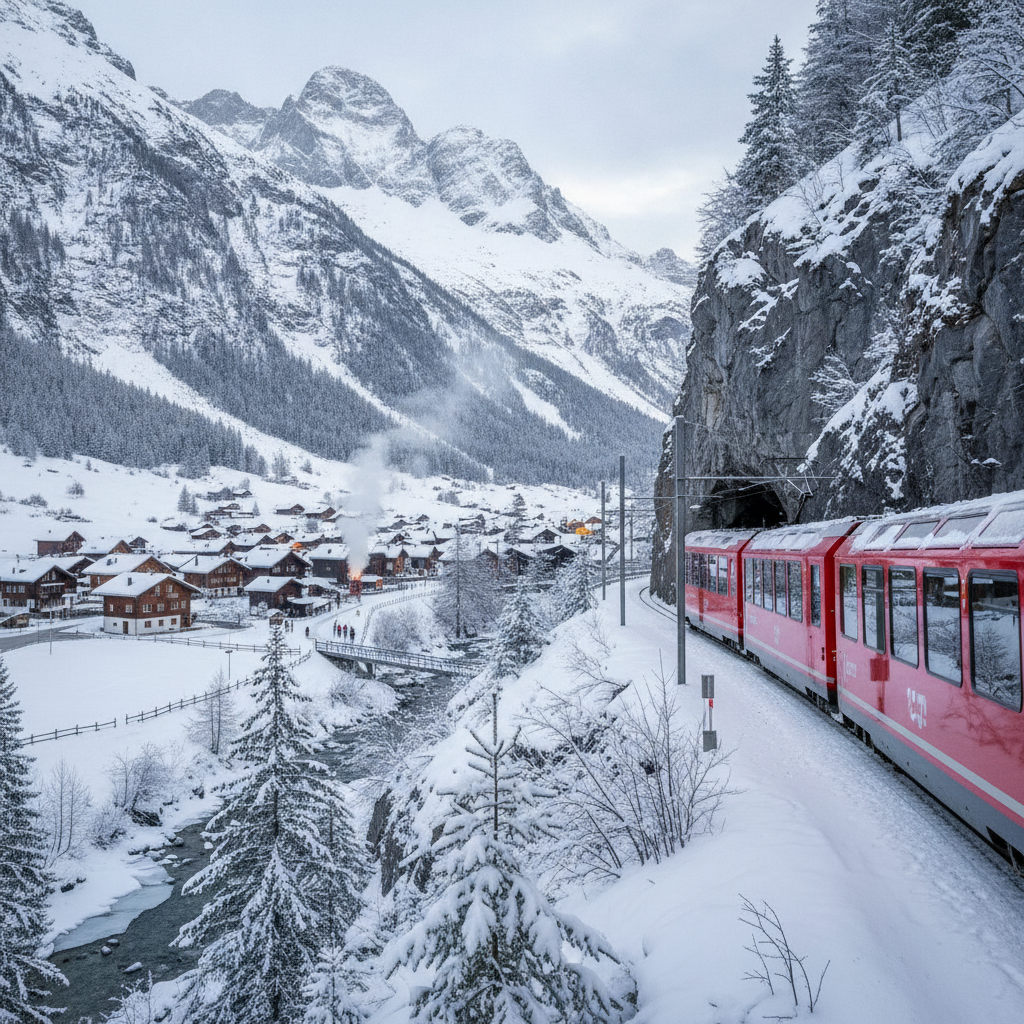
Winter has a way of revealing the true character of a place. Strip away the summer crowds, the guided tour buses, and the shoulder bags bumping against café tables, and what remains in the Swiss Alps is something remarkably quiet — frost-edged valleys, amber lantern light spilling from timber guesthouses, and train platforms where you might be the only person boarding. For travelers willing to time their journeys around the cold months, Switzerland's thermal rail network offers one of the most underappreciated combinations of comfort, scenic beauty, and genuine affordability in all of European travel.
The Quiet Power of Winter Rail Travel in Switzerland
Switzerland's rail infrastructure is among the most sophisticated in the world, and during winter, it operates with the same clockwork precision that defines the country's reputation. Heated carriages, panoramic windows, and punctual departures make cold-weather train travel genuinely comfortable rather than merely tolerable. The key insight for savvy travelers is that the same routes that carry skiers toward the major resorts also pass through smaller, lesser-visited villages — stops that most passengers simply ignore in their rush toward Zermatt or St. Moritz. Those overlooked stations are exactly where the value lies, and reaching them requires nothing more than flexibility and a willingness to step off where the crowds don't.
Understanding Which Routes Open the Right Doors
The Glacier Express Corridor
The Glacier Express between Zermatt and St. Moritz is one of Switzerland's most famous scenic routes, but the villages it threads through — places like Disentis and Andermatt — tend to be skipped entirely by tourists fixated on the endpoints. Andermatt in particular has seen careful development over recent years while retaining a genuine alpine character that larger resort towns lost decades ago. Winter pricing in these corridor villages can run significantly lower than the marquee destinations, and the rail connection means you're never truly isolated — a feature that makes the trade-off feel entirely risk-free for first-time winter rail travelers.
The Bernina Line Through the Engadin
The Bernina Express, running between Chur and Tirano in Italy, crosses some of the most dramatic terrain in the Alps and is a UNESCO World Heritage route. In winter, the snowfields flanking the viaducts take on a stillness that summer photographs simply can't capture. Smaller stops along this line, such as Poschiavo, offer stone-built village centers, local restaurants where the menu changes daily, and accommodation rates that reflect a local economy rather than a tourist one. Booking a few nights here rather than in a polished resort town isn't a compromise — it's a different kind of trip entirely, one built around atmosphere rather than amenity counts.
Timing Your Journey for Maximum Value
The pricing dynamics of Swiss winter travel follow a clear pattern. The weeks immediately surrounding Christmas and New Year's see elevated rates across the board, and the school holiday periods in February push resort-adjacent accommodation to peak levels. The windows that consistently offer the most favorable conditions fall in early December — before the holiday rush solidifies — and in the stretch from mid-January through early March, after the New Year crowds have thinned but before spring shoulder season begins. These are also the weeks when snowpack tends to be reliable, daylight hours are gradually extending, and village life settles into a calm, unhurried rhythm that feels genuinely restorative.
Planning and Booking the Smarter Way
Rail Passes Worth Knowing
The Swiss Travel Pass remains the most flexible option for multi-day rail exploration, covering nearly the entire SBB network including scenic mountain routes. It's available through the SBB mobile app, which also handles real-time timetables, seat reservations, and connection alerts — making it practical enough to rely on entirely from a smartphone. The Eurail app is worth considering for travelers entering Switzerland as part of a broader European itinerary, since it integrates cross-border connections and allows pass holders to add Swiss routes without purchasing a separate domestic product. For day-by-day planning, the Rome2rio platform offers useful rough overviews of connection options across smaller regional lines that don't always appear on international booking engines.
Finding Accommodation Off the Resort Map
In villages like Pontresina, Vals, or Scuol — each reachable by rail with minimal connections — guesthouses and small family-run hotels operate with rates calibrated to a local visitor base rather than an international one. Booking directly through property websites, rather than through large platforms, often surfaces rates that aren't publicly listed alongside the standard commission-inflated options. Reaching out a few weeks in advance with a straightforward inquiry in English is generally welcomed, and some properties offer small reductions for stays of three nights or more during the quieter January window.
What Arrives With the Slower Pace
Traveling through the Alps by rail in winter, without a resort itinerary to anchor every day, creates a particular kind of openness. Villages that would feel crowded in July become genuinely approachable — the local bakery has space at its counter, the innkeeper has time to describe the afternoon walk to the frozen waterfall, and the experience of arriving somewhere by train and simply wandering until the cold draws you into a warm interior is one that most travelers don't associate with Switzerland at all. The country's reputation for expense is real in its flagship destinations, but it softens considerably once the rail lines carry you past the famous names and into the quieter geography between them.
Preparing for the Conditions That Come With the Season
Winter rail travel in the Alps rewards light, thoughtful packing. Layering systems outperform heavy single coats when moving between heated trains and cold platforms, and waterproof footwear matters considerably more than it would on a summer trip. The SBB app sends weather-related service alerts for mountain routes, which is worth monitoring in the 48 hours before any journey into higher elevations. Most scenic trains require a reservation supplement even for pass holders, and booking those slots a week or two in advance during the quieter January period is generally straightforward — though the Glacier Express and Bernina Express fill faster than their reputations might suggest, even in the off-season.
There's a particular satisfaction in arriving at a Swiss mountain village by train in January, stepping onto a quiet platform with a dusting of fresh snow on the roof of the station shelter, and realizing that the experience costs a fraction of what it would in August — not because anything essential is missing, but because the season itself has done the work of clearing the space. The trains still run precisely, the mountains are no less dramatic, and the villages haven't changed their character simply because fewer people thought to look. That's the quiet reward waiting for anyone willing to plan around the cold rather than away from it.