There is a particular kind of restlessness that comes from arriving somewhere too quickly. A traveler steps off a flight, collects a bag, and finds themselves standing in a city they've dreamed about, yet feeling curiously unmoored — as though the place hasn't quite registered, or they haven't quite registered to it. The journey and the destination exist as two separate events, disconnected by altitude and time zones and the strange compression of modern travel. The slow boat along the Mekong River, running roughly 300 kilometers between the Thai border town of Huay Xai and the ancient royal city of Luang Prabang in northern Laos, offers something genuinely different: a crossing that dissolves the boundary between traveling and arriving, turning the two days on the water into the experience itself.
The Rhythm of the River as a Travel Philosophy
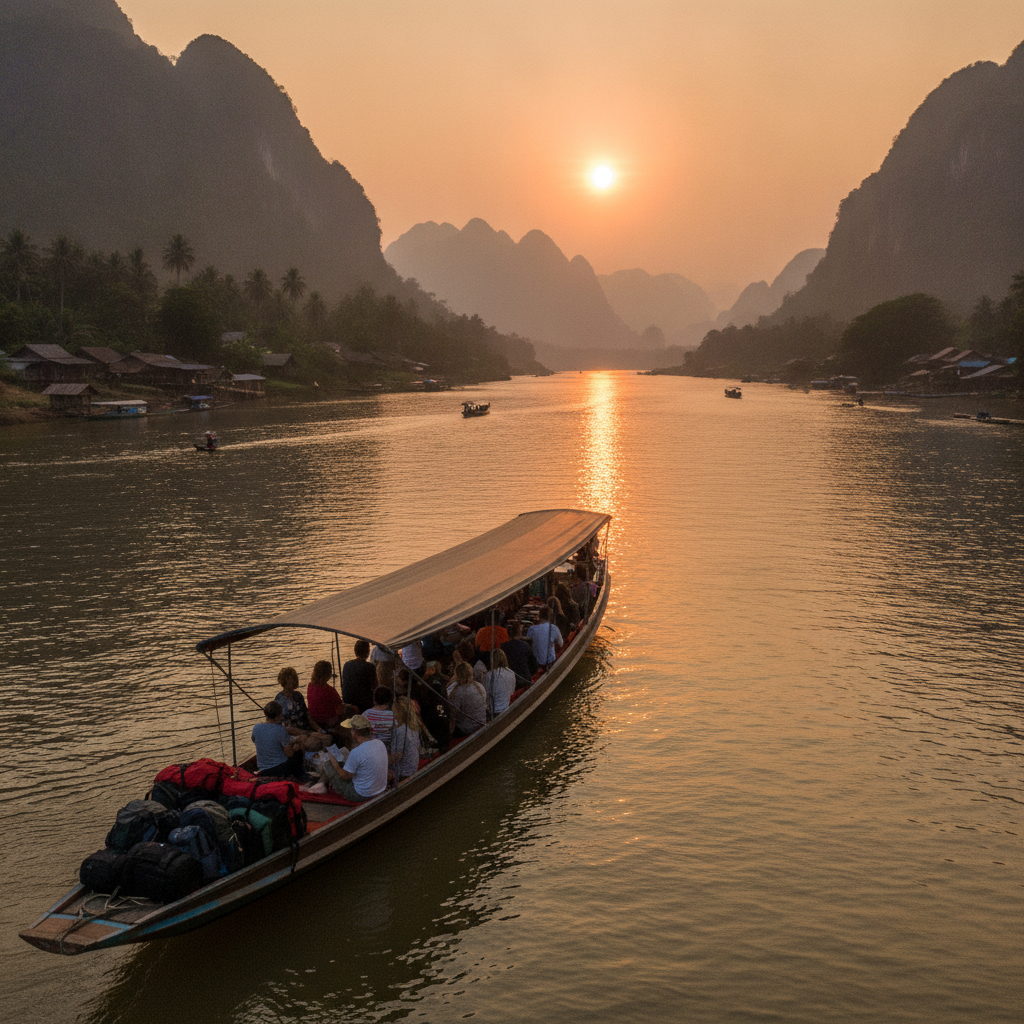
The heua wai, or slow boat, is not marketed as a luxury product, and it doesn't pretend to be. Wooden-hulled vessels, typically fitted with cushioned bench seating and open windows that frame the passing jungle, carry passengers along one of Southeast Asia's great waterways at a pace that feels almost geological by modern standards. The journey takes approximately two days, with an overnight stop in the riverside village of Pakbeng, and that unhurried pace is precisely the point. The river dictates the schedule, narrowing and widening between limestone karsts, past fishing communities whose stilted houses lean over the current like they've been listening to it for generations. Travelers who board expecting speed or efficiency tend to arrive transformed, not despite the slowness but because of it. The Mekong doesn't deliver a destination — it introduces one.
Pakbeng, the midpoint settlement where passengers disembark for the night, illustrates this beautifully. It's a small town built almost entirely around the logic of the river — guest houses, noodle stalls, and open-air restaurants arranged along a single main street that climbs steeply from the dock. There's little to do there in any conventional tourist sense, and that absence of agenda is quietly instructive. Evenings in Pakbeng have a particular quality: the generators run, the bamboo lanterns glow, and travelers who might never otherwise speak at length find themselves comparing impressions of the river they've shared all day. The baci ceremony, a traditional Lao blessing ritual in which white strings are tied around a guest's wrists to bind good spirits to the body, is sometimes offered in villages along this stretch, and encountering it in a place as unhurried as Pakbeng gives it a weight that a scheduled cultural performance in a larger city rarely achieves.
What the Landscape Does to the Sense of Time
The Mekong between Huay Xai and Luang Prabang passes through some of the most visually consistent and emotionally affecting scenery in all of Southeast Asia. The hills are dense and steeply folded, dropping almost directly into the water in places, their green so saturated it reads as implausible in photographs. Villages appear at intervals — sometimes a cluster of homes with a longtail boat tied to a makeshift dock, sometimes just a single structure with laundry drying on a line — and then disappear again behind the next bend. This rhythm of appearance and absence does something measurable to the traveler's internal clock. The urgency that most people carry into airports and transit hubs begins to loosen within the first few hours. By the second morning, many passengers report a shift in how they're processing the world around them: more slowly, more attentively, with less need to photograph everything and more inclination simply to watch.
This is not a small thing. Much of what frustrates modern travel — the sense of moving through places without absorbing them, of collecting destinations rather than inhabiting them — stems from the speed at which most journeys are conducted. The slow boat imposes a different contract. There's nowhere else to be, nothing to optimize, no connection to catch. The river is the itinerary, and the itinerary cannot be rushed. Travelers who surrender to that logic tend to arrive in Luang Prabang in a state of unusual receptivity, already oriented to the city's own unhurried character before they've set foot on its streets.
Arriving in Luang Prabang by Water
Luang Prabang is a UNESCO World Heritage city, and it carries that designation with a kind of quiet confidence — temple-lined streets, monks in saffron robes conducting the tak bat alms-giving procession each dawn, French colonial architecture softened by decades of tropical humidity. Most visitors arrive by plane into Luang Prabang International Airport, which is efficient and perfectly functional, and they emerge into the city with no particular transition between the world they left and the one they've entered. Those who arrive by slow boat have already spent two days inside a landscape that belongs, entirely and unmistakably, to this part of the world. The river deposits them at the city's edge having already begun the work of adjustment.
The dock at Luang Prabang sits below the main town, and the walk up from the water — past fruit sellers and tuk-tuk drivers and the smell of lemongrass from nearby kitchens — functions almost ceremonially. The journey has prepared the traveler for the place in ways that no amount of reading or itinerary-building can fully replicate. Luang Prabang's pace, its attentiveness to beauty, its insistence on the present moment — all of these feel less like discoveries and more like continuations of what the river already started.
Planning the Journey Practically
For travelers considering the route, a few practical details shape the experience considerably. Tickets are purchased through guesthouses in Huay Xai or directly at the boat dock, and the slow boat typically departs around 11 a.m. on each of the two travel days. The Luang Say Lodge, a mid-range option near Pakbeng, offers a notable step up in comfort for the overnight stop, though many budget travelers find the simpler guesthouses along the main street more than adequate and more atmospherically consistent with the journey itself. Bringing a small daypack onto the boat rather than accessing checked luggage is standard practice, and packing snacks matters — food options on board are limited, though vendors sometimes appear at riverside stops. The rainy season, roughly June through October, makes the river run faster and murkier but adds its own drama to the landscape; the dry season, November through April, offers calmer, clearer water and easier traveling conditions.
When you finally step off the boat in Luang Prabang, carrying two days of river light and jungle green and the particular quiet of moving water, the city will meet you differently than it meets those who arrived by air. You'll have earned the arrival not through hardship but through patience — through the willingness to let a journey be more than the means to an end. That is what the slow boat teaches, slowly and without announcement: that the distance between two places is not wasted time waiting to be minimized, but the very thing that makes arriving somewhere feel like it matters.