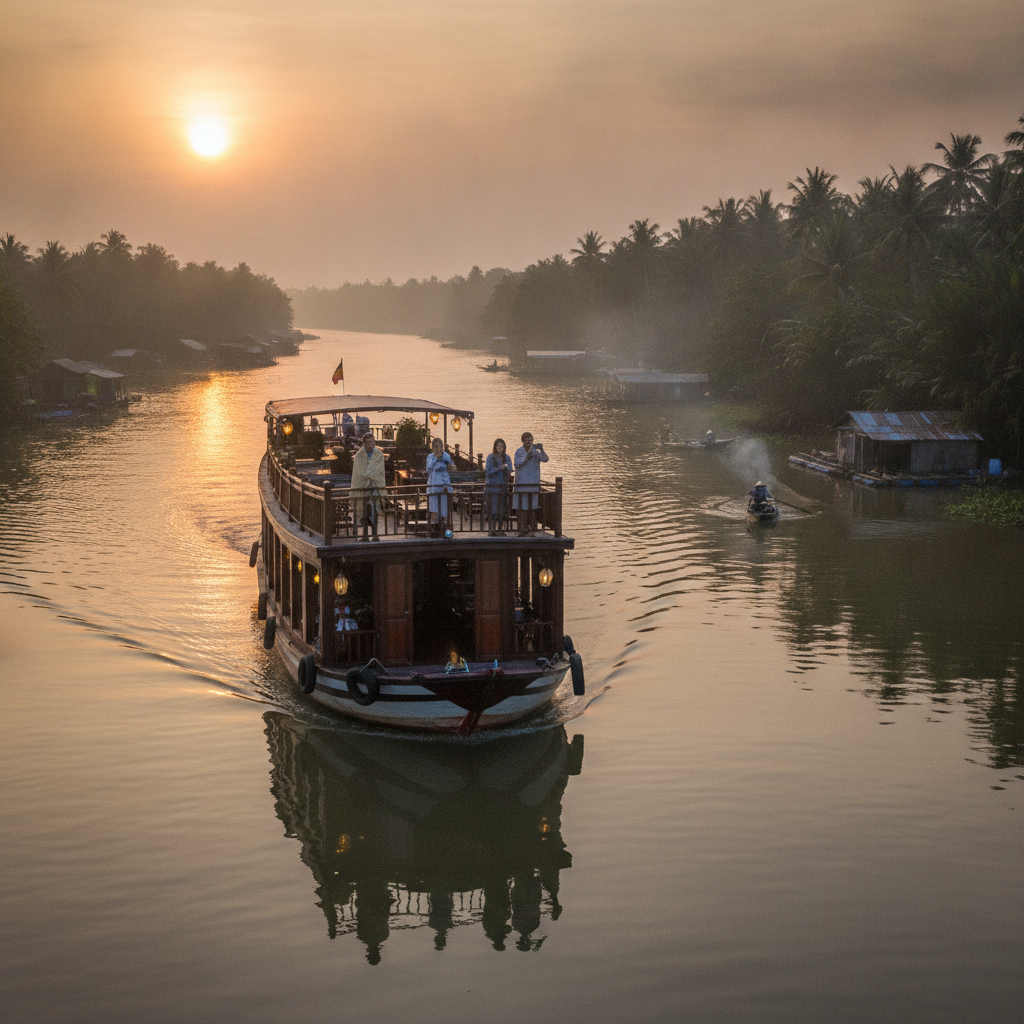
The Mekong Delta does not reveal itself quickly. It is a place that unfolds slowly, in the gray light before sunrise when the river mist hasn't lifted, in the sounds of wooden boats loading crates of dragon fruit at 4 a.m., in the particular silence that settles over the water once the last diesel engine cuts out at dusk. Day tours, however well-intentioned, skim the surface of this world. Overnight river cruise segments go somewhere deeper.
What Day Tours Tend to Leave Behind
Most visitors to southern Vietnam arrive in Can Tho or My Tho, join a guided day boat, and return to Ho Chi Minh City by early evening. The experience is pleasant, even memorable in its own way. But the Mekong Delta is fundamentally a nocturnal and early-morning economy, and those hours are precisely what day tours don't offer. The floating markets at Cai Rang, for instance, are in full swing by 5 a.m. and winding down well before most tour boats arrive. What day visitors see is the aftermath — quieter stalls, fewer vendors, a market in its final hour rather than its prime.
The rhythm of delta life is tied to water levels and light in ways that only become clear after spending a night on or near the river. Families load produce by lantern light. Fishermen sort their catch before dawn. The banks transform between 10 p.m. and 6 a.m. in ways no daytime visit captures.
The Structure of an Overnight Segment
Overnight cruise segments in the Mekong Delta typically run between two and four nights, connecting towns like Chau Doc, Long Xuyen, and Can Tho along branching waterways that don't appear on standard tourist maps. Operators such as Bassac Cruises and Heritage Line's smaller Mekong vessels offer cabins aboard converted wooden junks or colonial-style river boats, traveling at a pace that prioritizes observation over distance. These aren't luxury liners — they're intimate, often carrying fewer than twenty passengers, which changes the entire social dynamic of the journey.
Because the boat moves through the night, passengers wake to a different stretch of river each morning. The landscape shifts from wide open channels to narrow canals lined with water hyacinth, from industrial river towns to villages accessible only by water. That gradual transition — felt rather than simply viewed — is what distinguishes the overnight format.
Morning on the Water and the Floating Markets
Reaching Cai Rang floating market before 5:30 a.m. aboard an overnight vessel is a fundamentally different experience from arriving at 8 a.m. on a day tour. The *chợ nổi* (floating market) is at peak activity in those early hours, with hundreds of boats trading wholesale fruit and vegetables, their bows stacked with whatever they're selling — a local system called *cây bẹo*, where vendors hang a sample of their goods on a tall pole so buyers can identify them from a distance. Seeing this in full operation, then watching it gradually quiet as the sun rises, gives travelers a complete picture of how the market actually functions as a commercial system, not a performance.
Breakfast comes shortly after, often served on deck as the boat continues moving. The contrast between the pre-dawn market chaos and the stillness of the open river an hour later is striking. That contrast, repeated across two or three mornings, builds into genuine understanding.
Cultural Terms Worth Knowing Before You Go
Traveling the Mekong Delta with some linguistic and cultural context makes the experience significantly richer. *Sông* means river, and locals use it constantly in reference to specific channels and tributaries. *Bến* refers to a landing or dock — you'll hear it in place names throughout the region. The communities along the delta include ethnic Khmer villages, Cham Muslim communities, and Vietnamese Buddhist settlements, often within a few kilometers of each other, each with distinct architectural styles and daily schedules. Overnight travel allows passengers to observe these communities at natural moments — temple bells at dawn, evening prayers, children walking to school along raised canal paths — rather than during choreographed village stops.
The *áo bà ba*, the traditional loose pajama-style clothing worn by many older delta residents, is a marker of regional identity distinct from urban Vietnamese fashion. Seeing it worn casually, by a woman steering a sampan or a man repairing nets, situates it in context that no museum exhibit can replicate.
Choosing the Right Segment for Your Itinerary
The most rewarding overnight segments tend to follow the upper delta routes, particularly the stretch between Chau Doc near the Cambodian border and Can Tho, which combines open river travel with narrow canal passages and passes through distinctly rural territory. A two-night segment fits naturally into a broader southern Vietnam itinerary without requiring a complete restructuring of travel plans. Travelers coming from Ho Chi Minh City can reach Chau Doc by bus or private transfer in about four hours, and disembark in Can Tho at the end of the cruise before heading onward.
Booking directly through reputable operators rather than aggregator platforms often yields better communication and more flexibility around departure times. Checking in with Mekong Eyes or Toum Tiou for smaller, locally operated vessels is worthwhile for travelers who prefer a more community-connected experience over polished hospitality.
What You Carry Home From the River
There's a specific quality of knowledge that comes from sleeping somewhere unfamiliar and waking inside it the next morning. When you spend the night on a Mekong river vessel, you wake up already belonging to the place in a small way — your body has adjusted to its sounds, its smells, the particular way the boat moves at anchor. The day tourists who arrive later are starting from zero. You are not.
That distinction sounds subtle, but it shapes everything about how you perceive what you're seeing. The delta's complexity — its layered cultures, its working-river economy, its unhurried pace — becomes legible in a way it simply doesn't from the back of a boat that needs to return to the dock by five. The Mekong Delta is a place that withholds its most honest character from those who aren't willing to stay long enough to earn it. Overnight travel is, in the end, less about comfort or convenience and more about being present for the hours that actually matter — the same hours the delta has always kept, long before tourism arrived.