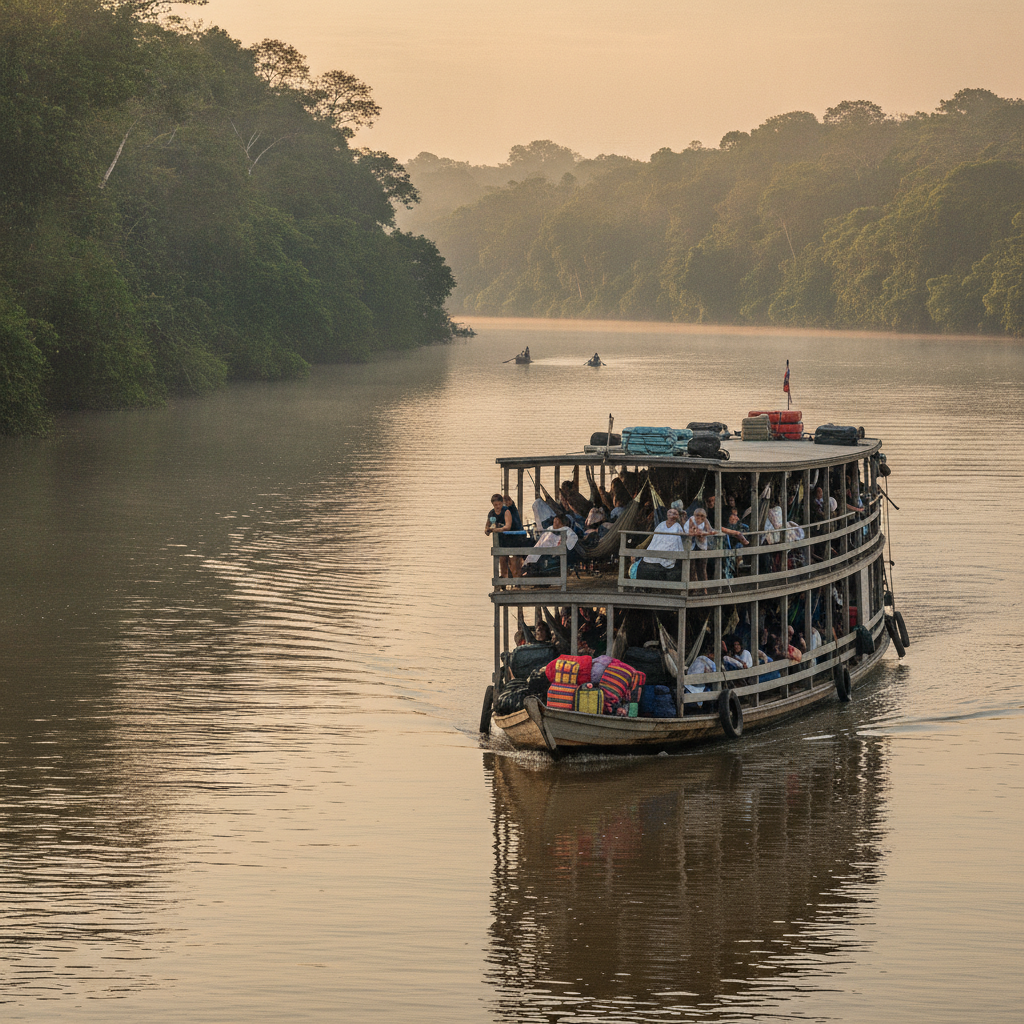
Travel is rarely just about arriving somewhere — it is about what gets rearranged inside you along the way. Nowhere does this truth become more apparent than on the great waterways of the Amazon Basin, where choosing a hammock-strung river boat as your primary mode of transport shifts everything: the pace, the sensory texture, the social fabric, and the fundamental way time feels. Most travelers who pass through Manaus or Belém treat the river as scenery, glimpsed from the window of a connecting flight or a rushed port excursion. Those who step aboard a wooden embarcação — a working passenger vessel that follows the river's own timetable — discover something the aerial route cannot offer: the Amazon as a living corridor rather than a backdrop.
The Architecture of River Travel
The boats that ply the Rio Solimões, the Rio Negro, and the main Amazon channel between Manaus and Belém represent a distinct category of transport that sits somewhere between infrastructure and way of life. These multi-deck vessels, operated by companies such as Amaetur and Riosul, carry not only tourists but families relocating between river communities, merchants transporting goods, and schoolchildren returning home from distant towns. The embarcação is organized around shared space: rows of colored hammocks strung inches apart on the open middle deck, with small private cabins available on the upper levels for those who prefer them. Life onboard moves to the rhythm of the river current rather than any posted schedule, and that distinction reshapes everything from appetite to conversation.
The most significant shift happens in the first few hours after departure, once the port cities have faded behind a wall of green. The vessel's engine settles into a low, continuous thrum, and the forest begins to make its presence felt — not dramatically, but steadily. River dolphins, known locally as botos, surface near the bow. Kingfishers trace low arcs across the brown water. Villages of five or ten houses appear briefly along the bank, their inhabitants watching the passing boat with the calm familiarity of people for whom this vessel is simply the weekly connection to the wider world. The traveler who surrenders to this tempo rather than resisting it finds that the journey stops feeling like transit and begins feeling like immersion.
Community as Constant Companion
What separates an Amazon river crossing from most other long-distance transport is the quality of unplanned human contact it generates. On an overnight flight or a cross-country bus, fellow passengers tend to retreat into screens and headphones, creating a kind of enforced privacy. On a river boat, the hammock deck erases that option almost entirely. Meals are served communally in a small canteen — rice, beans, fish pulled from the river that morning — and the long hours between river bends produce a natural sociology. Conversations begin in Portuguese, drift into the regional dialect spoken across Pará and Amazonas states, and occasionally cross into other languages entirely as travelers from Europe and Asia find common ground in shared bewilderment at the forest's scale.
This social dimension is not incidental to the travel experience; it is central to it. The river towns of Santarém and Parintins are not places most international itineraries include, yet they appear naturally during a multi-day river crossing and become genuine stops rather than names on a map. Parintins, famous for the Boi-Bumbá festival — a weeks-long celebration of Amazonian folklore involving enormous theatrical productions, competing teams, and deep roots in indigenous and mestizo culture — becomes a real destination rather than a trivia fact when the boat pulls into its dock and local passengers stream off to greet waiting families.
What Overnight Crossings Reveal
The night portion of a multi-day river journey earns its own category of consideration. Sleeping in a hammock aboard a moving vessel on the Amazon is not especially comfortable by hotel standards, but comfort, here, is not quite the point. The air at night on the river is cooler than the daytime heat suggests possible, carrying the particular green heaviness of equatorial forest after dark. The sounds shift: the engine continues its steady note, but the human noise of the deck quiets, and what comes through instead are the river itself, the occasional call of a nightbird from the bank, and the gentle swaying that most people, unexpectedly, find they can sleep within.
Waking at dawn on the river produces one of the more disorienting pleasures in South American travel. The fog that collects over the water in the early hours gives the forest wall a quality that is difficult to describe and impossible to replicate through other means. Photographers who have timed their Amazon visits around this light, rising at first gray to position themselves at the boat's stern, will confirm that no ground-level approach to the forest produces the same combination of scale and intimacy. The river offers a perspective that road access — still limited across much of the basin — simply cannot match.
Practical Wisdom for Boarding and Settling In
For those considering this approach, a few practical realities shape the experience significantly. Hammocks must be strung early after boarding — on routes departing from Manaus, boats can fill well beyond comfortable capacity during peak travel periods, and late arrivals find only awkward corner positions. Bringing a lightweight liner rather than a sleeping bag suits the climate far better. Food onboard is simple and filling, but carrying personal snacks, water purification tablets, and a small padlock for securing a bag to the hammock frame are habits that experienced river travelers consider standard.
Documentation requirements for the main channel between Manaus and Belém are straightforward for most nationalities, but border regions involving tributaries closer to Peru or Colombia carry different considerations, and checking current entry requirements before departure from either city remains important. The IBGE — Brazil's national statistics and geography institute — publishes updated regional maps that help orient travelers to the river system's structure before they board.
When you step off the boat after two or three days on the water, something in your internal calibration will have shifted. Cities feel louder and faster than they did before. The impulse to hurry, which most modern travel reinforces at every stage, has been quietly interrupted by a system that runs at the river's pace rather than the traveler's preference. That interruption is, in the end, what the Amazon river boats are really offering — not just transport between two points on a map, but a rearrangement of what a journey is allowed to feel like. The broad, slow water that opened this experience will stay with you long after the hammock has been rolled up and the dock lights of Belém have come into view.