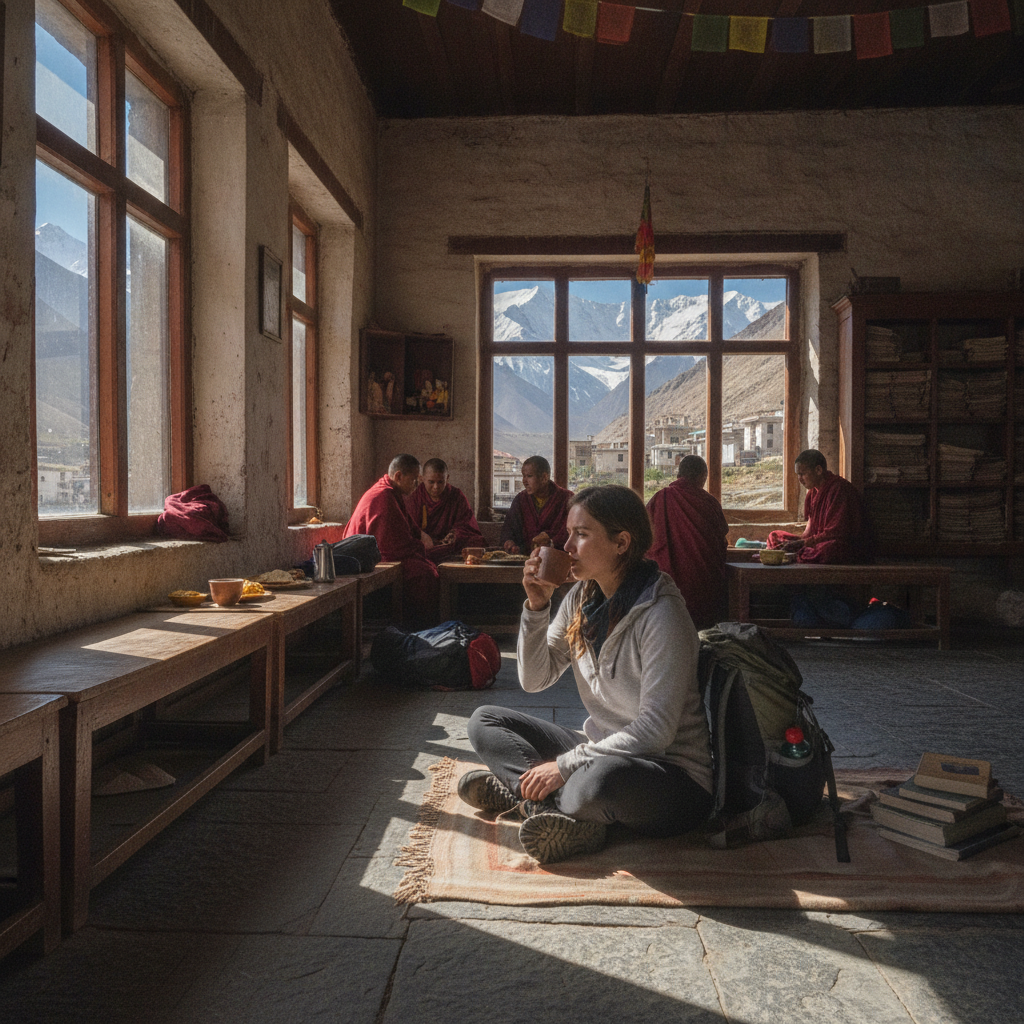
There is a particular kind of exhaustion that settles in after several nights in a crowded hostel — the hum of strangers' conversations bleeding through thin walls, the unpredictable rhythms of shared bathrooms, the subtle erosion of stillness that most travelers don't notice until it's already gone. Northern India, with its dense network of Buddhist monasteries scattered across Ladakh, Spiti Valley, and the foothills of Himachal Pradesh, offers a genuinely different proposition — one that costs less, asks more of the traveler, and tends to return far more in exchange.
The Quiet Economy of Monastic Hospitality
For centuries, Buddhist monasteries across the Himalayan belt have maintained a tradition of offering shelter to pilgrims, scholars, and wandering monks. That same spirit of hospitality has gradually extended, with care and some structure, toward secular travelers willing to engage respectfully with monastic life. In Ladakh alone, gompas — the Tibetan and Ladakhi word for monastery — such as Hemis, Thiksey, and Diskit have developed informal or semiformal programs that allow visitors to stay within the monastery grounds for a modest daily contribution, often covering a simple room and two meals. The cost is rarely fixed with the rigidity of a hotel rate, but it consistently falls well below what even the most basic guesthouse in Leh charges during the summer season. What travelers receive in return is not just affordable shelter but proximity to a living, breathing community with its own daily architecture of time.
Understanding How These Programs Actually Work
Monastery stay arrangements in northern India don't function like booking a hostel bed on Hostelworld. Most require direct outreach — arriving in person, sending a respectful message through a monastery's associated cultural organization, or connecting through a local guide in towns like Kaza or Padum. Organizations such as the Spiti Ecosphere in Kaza and the Ladakh Ecological Development Group in Leh have, over time, created more structured pathways for travelers interested in monastery-based stays, offering guidance on appropriate conduct, suggested contributions, and realistic expectations. Stays are typically negotiated for minimum periods of two to three nights, partly because single-night guests disrupt the community without offering much in return. Rooms are simple — a bedroll on a wooden platform, perhaps a small window looking onto a courtyard — and the monastery's rhythm governs the day rather than the traveler's preferences.
Daily Life and the Practice of Sewa
The most meaningful and occasionally challenging aspect of monastery stays is the implicit expectation of participation. Many programs invite, though rarely require, travelers to engage in sewa — a Sanskrit and Pali term meaning selfless service — which might involve helping in the kitchen, sweeping stone corridors, or carrying supplies. Morning prayers, called pujas, begin well before dawn in most monasteries, and while guests are rarely compelled to attend, the sounds carry freely through stone walls regardless. Travelers who approach this not as an inconvenience but as a form of cultural immersion tend to find that their understanding of Tibetan Buddhist practice deepens considerably over even a short stay. The experience shifts from observation to something closer to peripheral belonging, which is a different category of travel entirely.
What to Bring and How to Prepare
Practical preparation matters considerably more for a monastery stay than for a standard hostel booking. Electricity is intermittent in many Spiti Valley monasteries and occasionally absent altogether; a small solar lantern and a power bank are worth carrying. Modest clothing is essential — shoulders and knees covered at all times, not just during religious observances. Travelers should bring their own basic toiletries, a sleeping bag liner for cooler months, and ideally a phrasebook or language app with some basic Ladakhi or Tibetan phrases. Meals provided are typically simple and vegetarian — rice, dal, tsampa (roasted barley flour, a Tibetan staple), and butter tea, called po cha, which is an acquired taste but a warm one at altitude. Arriving with an open attitude toward simplicity, rather than a checklist of amenities to verify, makes the entire experience more fluid.
The Real Cost Comparison
When travelers do the arithmetic honestly, monastery stays in northern India are remarkably economical without requiring any sacrifice of safety or authenticity. A standard dorm bed in a Leh hostel during peak season runs to a meaningful daily cost; a private room in a mid-range guesthouse in Kaza runs higher still. Monastery contributions, by contrast, often include accommodation and two simple meals for a fraction of those figures, and the money goes directly to institutions maintaining centuries-old cultural heritage rather than to regional hospitality chains. Beyond the money, the intangible savings are substantial: no shared bathroom queues, no late-night noise, no performative sociality. The trade-off is comfort in the conventional sense, but what replaces it is a kind of ordered calm that most travelers find unexpectedly restorative.
Planning Your Monastery Stay
If you're drawn to this style of travel, the practical starting point is timing. The window between late May and early October keeps most high-altitude routes accessible, with monasteries in Spiti Valley reachable via the Manali-Kaza road and those in Ladakh via Leh's airport or the Manali-Leh highway. Contact Spiti Ecosphere directly for guided connections to monastery hosts in the Pin Valley and Tabo areas; for Ladakh, the Ladakh Ecological Development Group website provides current guidance on responsible tourism options. Arrive without firm checkout expectations, carry enough cash since digital payments remain unreliable at altitude, and plan to spend your first evening simply listening — to the low resonance of monastery horns, to wind moving across flat rooftops, to the particular silence that only high places seem to hold.
There is a particular kind of exhaustion, too, that lifts during these stays — the accumulated noise of itinerary-driven travel dissolving slowly in stone corridors and pre-dawn prayer. Travelers who seek out monastery programs in northern India rarely describe them as simply affordable alternatives to hostels. They tend to describe them as the part of the journey that made the rest of it make sense.