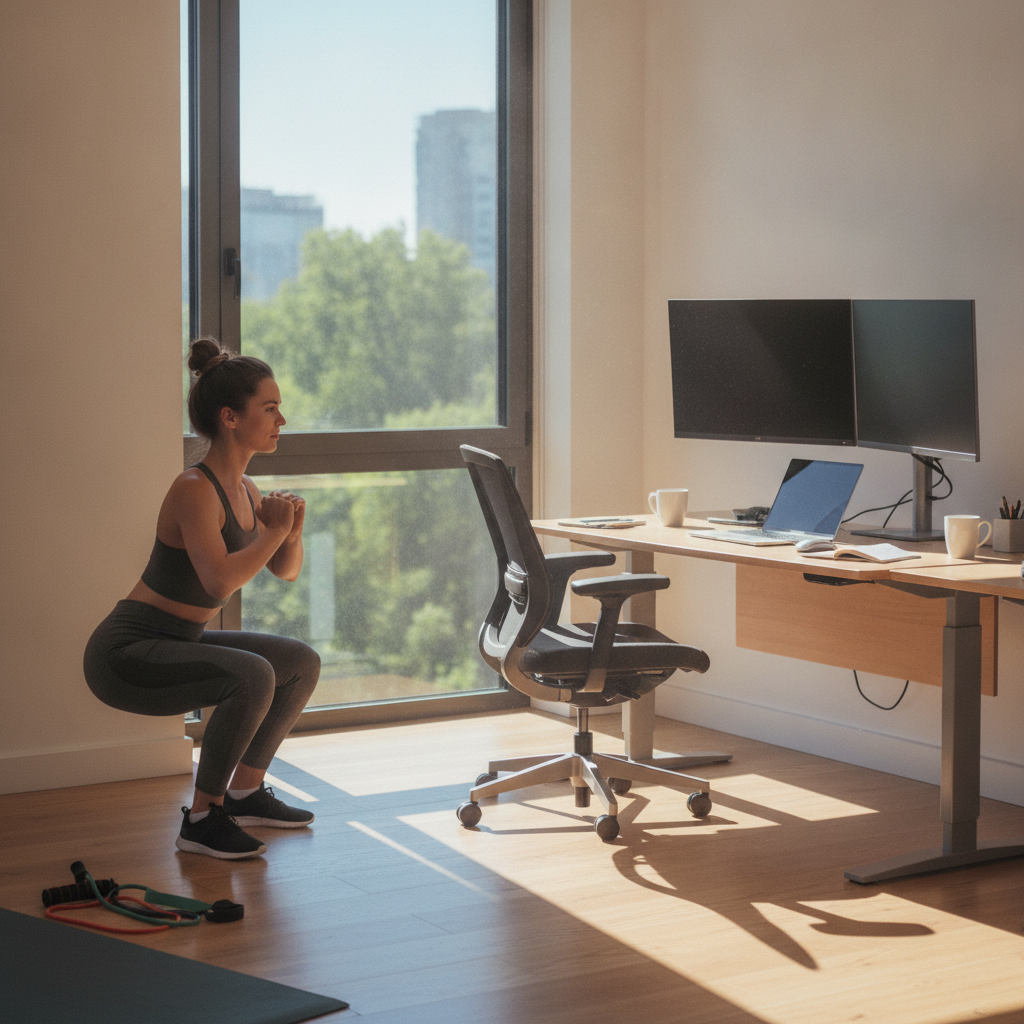
The human body was not designed to remain still for hours at a stretch, yet the demands of modern desk-based work have made prolonged sitting one of the most common physical stressors of contemporary life. Postural strain accumulates quietly — tightening hip flexors, compressing lumbar discs, and creating chronic tension across the shoulders and neck — often without any single dramatic moment of injury. The discomfort tends to build slowly, becoming the background noise of an entire working life. What research increasingly points toward is that the remedy doesn't require a gym membership or a complete lifestyle overhaul. Brief, targeted isometric exercises, woven into the rhythms of an ordinary workday, can meaningfully interrupt and reverse much of that accumulated strain.
What Postural Strain Actually Does to the Body
When someone sits for extended periods — particularly in the slightly forward-leaning posture that screens tend to encourage — several physical processes begin working against them. The deep stabilizing muscles of the spine, particularly the multifidus group along the lower back, gradually disengage and reduce their protective tone. Meanwhile, the hip flexors shorten and tighten, the glutes weaken, and the muscles of the upper back become overstretched as the shoulders round forward. Over time, these patterns create a kind of structural imbalance that doesn't simply resolve itself at the end of the workday. The body begins to default to these compromised positions even when standing, affecting gait, breathing mechanics, and energy levels.
Why Isometric Holds Offer a Targeted Solution
Isometric exercise involves contracting a muscle against resistance without changing its length — a wall sit, a plank hold, or pressing palms firmly together at chest height are all familiar examples. Unlike dynamic movement, isometric holds can be performed in confined spaces, without equipment, and without generating the kind of visible exertion that might feel awkward in an open office or on a video call. They're also remarkably efficient at re-engaging muscles that have gone functionally dormant during prolonged sitting. A twenty- to thirty-second hold, applied to the right muscle group, generates enough neuromuscular stimulus to restore activation patterns that hours of passive sitting have quietly suppressed. That efficiency is what makes isometric holds particularly well-suited to the realities of a desk-based workday.
The Key Muscle Groups That Benefit Most
Not all isometric holds deliver equal benefit for the sedentary worker. The most productive targets are the posterior chain — the glutes, hamstrings, and erector spinae muscles that support upright posture — along with the deep cervical flexors of the neck and the lower trapezius muscles of the mid-back. Glute contractions performed while seated, for instance, directly counteract the inhibition that prolonged hip flexion creates. Wall-supported thoracic extensions reactivate the mid-back muscles responsible for keeping the shoulders back and the chest open. Neck retractions, which involve gently drawing the chin straight back while seated, rebuild endurance in the small muscles that prevent the head from creeping forward toward the screen — a postural pattern that places considerable compressive load on the cervical spine.
Building a Practical Routine Around Work Intervals
The most effective approach to integrating isometric holds into a workday involves pairing them with existing behavioral anchors — transitions that already occur naturally throughout the day. The Pomodoro Technique, a widely used time-management method popularized by productivity tools like Toggl and Forest, involves working in focused twenty-five-minute blocks followed by short breaks, and those break intervals align almost perfectly with an isometric reset sequence. A standing desk, such as those made by Flexispot or Uplift Desk, can serve as both the transition cue and the physical support for certain holds. Even without specialized furniture, the simple act of standing up to take a phone call becomes an opportunity to add a fifteen-second calf raise hold or a static hip hinge that reactivates the posterior chain before returning to the chair.
How Consistency Reshapes Postural Patterns Over Weeks
A single isometric hold session produces a noticeable but temporary improvement in muscle activation and joint positioning. The more meaningful transformation happens through consistent repetition across weeks and months. When the body receives regular neuromuscular input that reinforces upright posture and posterior chain engagement, it gradually recalibrates its resting baseline — the default position to which it returns whenever active control relaxes. This process, sometimes called postural retraining, doesn't require heroic effort; it requires frequency and reliability. Three to five short sessions distributed across a workday consistently outperform a single longer session performed once daily, largely because the distributed approach interrupts the accumulating tension before it has time to solidify into the deeper compensatory patterns that become harder to unwind.
Getting Started With a Workday Isometric Sequence
For anyone ready to build this kind of practice into a real workday, simplicity is the best starting point. Begin with just three holds performed twice daily — once mid-morning and once mid-afternoon — and expand from there as the routine becomes automatic. A wall sit held for twenty to thirty seconds targets the glutes and quads while encouraging a neutral spine. A seated glute squeeze, held for the same duration while continuing to read or type, costs nothing in terms of lost work time. A standing thoracic extension against a doorframe, arms raised and elbows bent at ninety degrees while gently pressing the forearms back into the frame, counteracts the forward collapse of the upper back with surprising effectiveness. Apps like StretchIt or Centr can provide guided cuing for these movements, reducing the mental load of remembering what to do when a break finally arrives. You don't need to overhaul your entire schedule — you need to find four or five minutes within it, repeatedly, and let the cumulative effect build.
The broader truth about postural health in desk-based work is that it responds far more readily to small, consistent interventions than to periodic dramatic ones. Isometric holds ask very little of the workday in terms of time or logistics, and they return something proportionally significant — a body that carries itself better, tires less quickly, and accumulates less of the background tension that so often gets attributed simply to stress or aging. The problem of extended sitting is real, but the solution, it turns out, is far more accessible than most people assume.