There is a particular quality of light in the Moroccan countryside just before the evening call to prayer — amber and unhurried, settling over clay walls and almond groves with a kind of patience that commercial hotels seem architecturally designed to ignore. Travelers who have spent nights in family-run guesthouses across the Atlas Mountains or the Drâa Valley tend to carry that light with them long after returning home. It changes not just the memory of a trip, but the entire register of experience while the journey is still unfolding.
What a Maison d'Hôtes Actually Offers
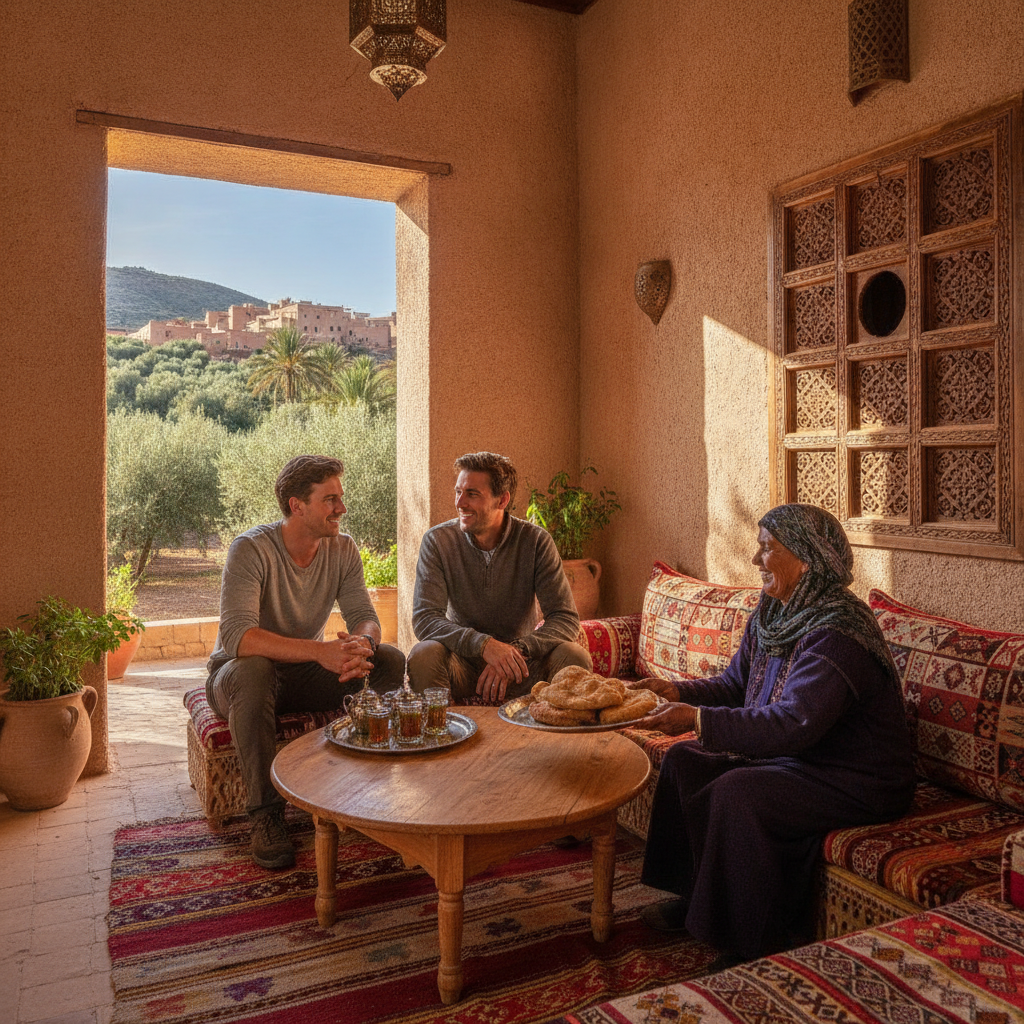
The term most commonly used across Morocco for a family-run guesthouse is *maison d'hôtes* — literally, a house of guests — and the phrase carries architectural as well as cultural meaning. These are often restored riads or rural farmhouses with thick earthen walls, interior courtyards, and rooms that open onto shared terraces rather than anonymous corridors. Unlike hotel chains, where the building exists to facilitate transactions, a maison d'hôtes exists because a family lives there and has chosen to welcome strangers into that life. The distinction sounds minor on paper, but it shapes everything: the smell of cumin rising from the kitchen each morning, the grandmother arranging dried herbs in the courtyard, the hand-painted zellige tilework that no catalogue could replicate. Guests are not checked in — they are, in the most functional sense, received.
The Aït Benhaddou region south of Marrakech and the Figuig oasis near the Algerian border both host deeply rooted family accommodation networks that have operated for generations. In villages like Imlil, at the foot of Mount Toubkal, families have converted portions of their homes into modest but carefully tended guest quarters, often staffed entirely by relatives spanning three generations. Booking through platforms like Gîtes du Maroc or even direct contact via local cooperatives puts money into the household rather than a corporate account — a detail that matters both ethically and experientially, because hosts with a genuine stake in the place tend to offer a quality of attention that cannot be trained into staff.
The Rhythms That Change When You Stay Close to the Ground
Spending even two or three nights in a family guesthouse rewires the pace of travel in ways that broader itineraries rarely achieve. Breakfast is not a buffet with printed cards — it is a spread assembled around what is available that week: *msemen* (a flaky, griddle-fried flatbread), argan oil pressed by hand, preserved olives from the family's own trees, and *atay* — the sweet, heavily steeped mint tea poured from height to produce its characteristic foam. These details are not performed for tourism. They are simply how the household eats, and the guest is folded into that ordinary fact. The effect is disorienting in the best sense: the traveler stops being a consumer of experience and becomes, briefly, a participant in someone else's daily life.
This shift in role changes how the surrounding landscape reads. When a host's teenage son offers to walk a guest to a less-visited canyon trail before school, or when a host explains which market stalls in Tinghir are run by neighbors and which are aimed at tour buses, the information arrives with a specificity that no travel guide can manufacture. Rural Morocco is a place where geography, agriculture, seasonal celebration, and family structure are still densely interwoven — and the family guesthouse is the portal through which that weave becomes legible to an outsider.
Hospitality as Cultural Practice, Not Service Industry
Moroccan hospitality operates within a framework that predates the tourism economy by centuries. The concept of *diyafa* — a deep cultural obligation to honor guests, feed them generously, and ensure their comfort — is not a marketing strategy. It is closer to a moral architecture, one that shapes how hosts behave regardless of whether the guest has paid a premium rate or arrived on a modest budget. Understanding this reframes the entire dynamic of staying in a family home. Accepting a second glass of tea is not a transaction; it is participation in a social ritual that has meaning for the host as well as the visitor. Refusing, by contrast, carries its own social weight — a gentle awkwardness that most experienced travelers learn to read and navigate with care.
For travelers moving through places like the Todra Gorge, the Saharan fringe near Merzouga, or the cedar forests of Azrou, this cultural current runs beneath every shared meal and every unhurried conversation at the end of the day. The guesthouse becomes a kind of field school in social attention — in learning to read pauses and gestures, in sitting with unfamiliar silences, in understanding that not everything offered needs to be consumed quickly to be appreciated.
Choosing Where to Stay, and Why It Matters
When you arrive in a small Moroccan village carrying a loose itinerary and a willingness to let the day be shaped by whoever is around, something unexpected tends to happen. The walls of the journey become permeable. A host mentions a local festival two valleys over; a cousin offers to guide you to a spring that appears on no map; the afternoon that was supposed to be spent walking becomes, instead, three hours learning to roll couscous in a kitchen that smells of coriander and woodsmoke. None of this is guaranteed, and none of it can be packaged. But it becomes possible — genuinely, consistently possible — when the place you sleep is also a home, and the people who cook your food have a name for every hill visible from the rooftop terrace. That texture, once experienced, has a way of making ordinary hotels feel not luxurious but simply quiet — and the difference between those two things is where travel, at its best, tends to live.