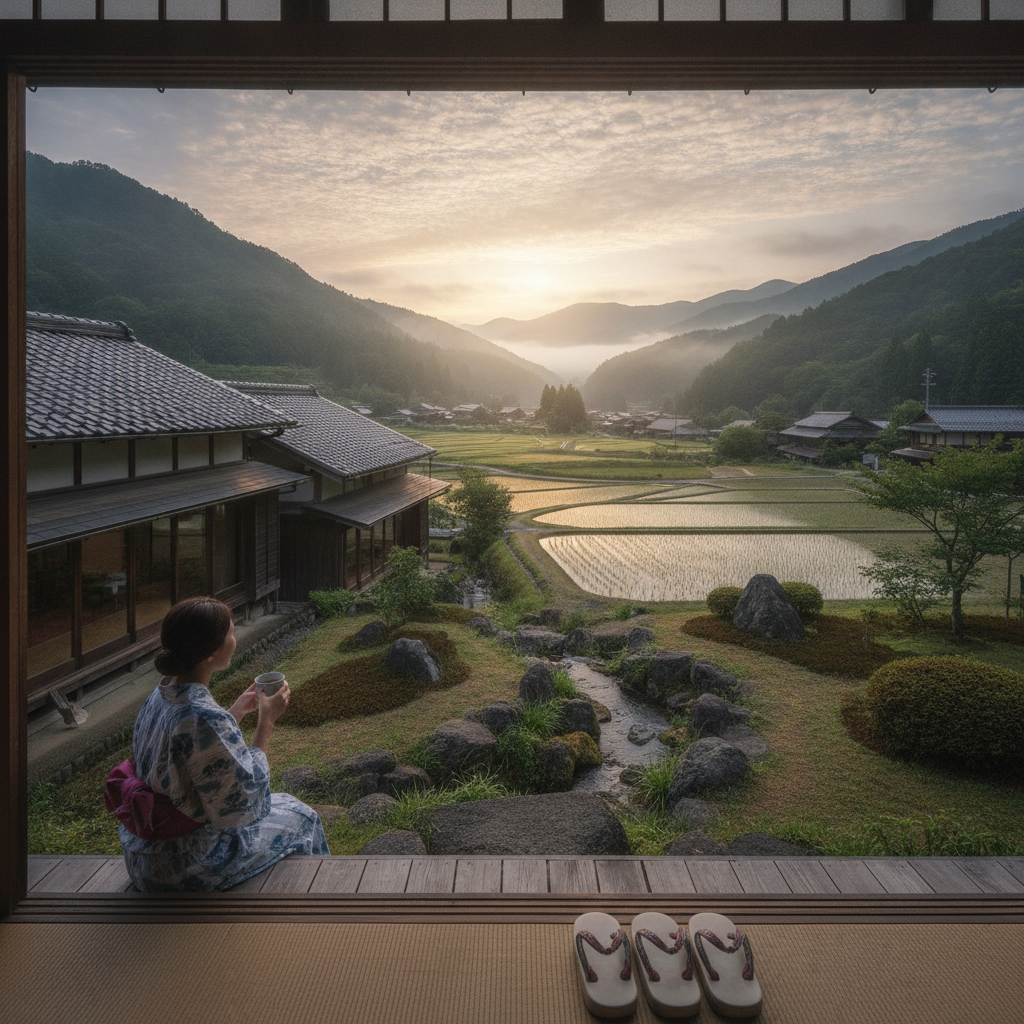
There is a particular kind of exhaustion that settles in around day four of a Japan itinerary built around Tokyo's Shinjuku district — the kind that comes not from walking too many kilometers, but from absorbing too much, too fast. The city is extraordinary, layered, and relentless in the best possible way, yet travelers who spend the full stretch of a two-week journey chasing its energy often arrive home with photographs but without stillness. The choice of where to sleep, it turns out, shapes everything else: the rhythm of mornings, the quality of meals, even the texture of memory.
The Architecture of a Ryokan Stay
A ryokan is not simply a Japanese inn — it is a structured philosophy of hospitality built around the concept of *omotenashi*, a word that translates loosely as selfless, anticipatory service. Guests remove their shoes at the entrance, change into a cotton robe called a *yukata*, and move through spaces where every surface seems calibrated for calm. Traditional ryokan in countryside prefectures like Nagano, Yamagata, or the Izu Peninsula are organized around the rhythms of nature rather than convenience. Check-in happens in the late afternoon so guests can bathe before dinner; check-out follows a morning that moves at the speed of tea. This is not inefficiency — it is architecture designed to slow the nervous system down deliberately.
How the Countryside Setting Amplifies the Effect
The setting does significant work. Staying in a rural ryokan near Kinosaki Onsen in Hyogo Prefecture or along the Nakasendo trail between Magome and Tsumago places a traveler inside a landscape rather than adjacent to one. Mornings begin with the sound of water, birdsong, or wind through cedar rather than the mechanical percussion of an urban streetscape. The surrounding environment encourages a kind of unhurried attention that city hotels, however beautifully designed, structurally cannot offer. When the view from a sliding *shoji* screen is a garden moss, a stone lantern, or a steam rising from an outdoor *rotemburo* — a natural hot spring bath — the instinct to check a phone or plan the next move loses its grip almost immediately.
Meals as the Axis of Each Day
In most countryside ryokan, accommodation and meals are packaged together under a system called *ipppaku nishoku*, meaning one night and two meals. The evening meal, or *kaiseki*, is a multi-course affair rooted in seasonal ingredients sourced from the surrounding region — mountain vegetables, river fish, pickled produce that reflects the week's harvest. This is not a cultural performance arranged for tourists; it is how the inn has operated for generations. Breakfast the following morning arrives with the same care: grilled fish, miso soup with local tofu, small dishes of preserved plum, and rice cooked to a specific texture. When meals become the anchoring events of a day rather than interruptions between sightseeing, the entire trip reorients around sensation rather than logistics.
The Practical Effect on a Two-Week Itinerary
A two-week Japan itinerary that allocates even four or five nights across two different countryside ryokan changes character measurably. Travelers who split their time between, say, three nights in Kyoto, two nights in a ryokan near the Kiso Valley, three nights in Tokyo, and two nights in a coastal inn along Ise-Shima tend to return with a more complete sense of the country than those who stack city hotels end to end. The countryside segments function as reset points — they lower cortisol, deepen sleep in ways that city environments rarely allow, and create the mental space necessary to actually absorb what the busier stops offered. Japan's regional rail network, particularly the JR Pass system, makes these transitions efficient without being jarring.
What Gets Noticed Differently
Something shifts in perception after even one night in a well-chosen ryokan. The small rituals that might seem incidental in a city hotel — the way a staff member folds a towel, the specific placement of a ceramic cup, the temperature of a room adjusted quietly before arrival — begin to register as a coherent language. This attention carries over into how a traveler moves through the rest of the trip. After a night in a ryokan near Hakone with a view of Fuji through morning mist, even a crowded Tokyo neighborhood like Yanaka reads differently: slower, more textured, less overwhelming. The countryside stay recalibrates the senses rather than simply resting the body.
Finding the Right Fit
If you are planning a two-week Japan itinerary with this approach in mind, a few practical considerations will shape the experience significantly. Booking through platforms like Relux or Jalan — both Japanese-language services with English support — tends to surface more authentic options than international aggregators. Smaller ryokan with fewer than twenty rooms generally deliver a more personal version of the experience than larger resort-style properties. Communicating dietary restrictions before arrival matters more here than in city hotels, since the kaiseki menu is usually fixed. Choosing a ryokan within a short train ride of a regional hub — Matsumoto, Kanazawa, or Beppu, for instance — allows day trips without surrendering the countryside base entirely.
The traveler who steps off a rural train platform in the late afternoon, carrying less than they expected to need, walking toward a building that has stood in roughly the same form for a century, is not retreating from Japan — they are reaching toward its quieter center. The city hotels were never wrong choices, only incomplete ones. A two-week journey through Japan that includes at least a portion of nights in countryside ryokan returns something the itinerary might otherwise spend without noticing: the particular pleasure of arriving somewhere and feeling, almost immediately, that there is no place left to rush toward.