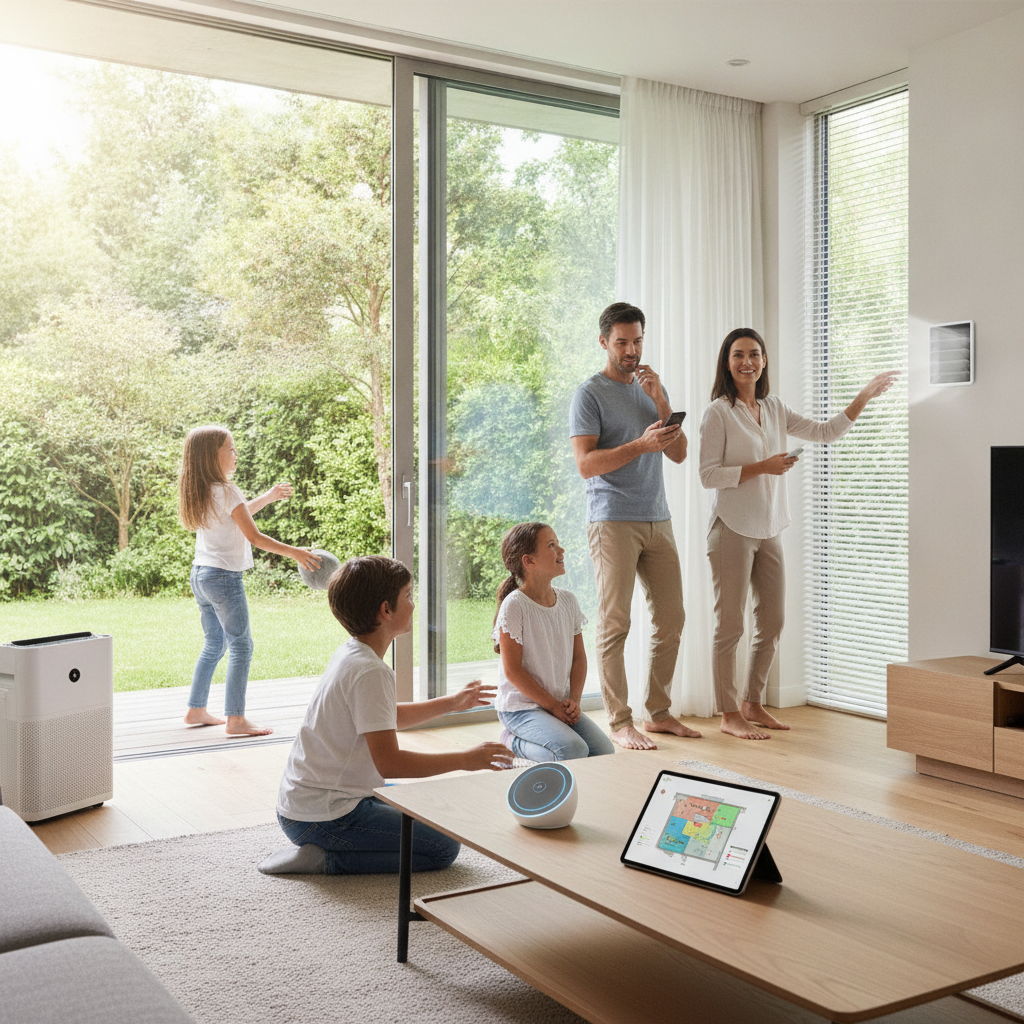
Most families spend the better part of their lives inside a building, breathing air they've never once thought to measure. The invisible mix of carbon dioxide, volatile organic compounds, humidity, and fine particulate matter that fills a home can shift dramatically throughout the day — after cooking, during sleep, when new furniture off-gasses in a freshly decorated room. For a long time, managing that air meant opening a window and hoping for the best. Compact smart air quality monitors are changing that entirely, and the way they're integrating with home automation platforms is quietly reshaping how households think about the air they share.
The Invisible Problem Most Households Overlook
Indoor air quality sits in a strange category: it affects how people feel every day — energy, focus, sleep depth, headache frequency — yet it remains almost completely invisible without the right tools. Particulate matter from cooking, formaldehyde from synthetic materials, and elevated CO2 from a room full of people can all accumulate without any obvious signal. The concept of *Sick Building Syndrome*, a term borrowed from occupational health circles, describes the cluster of symptoms that arise when indoor air turns stagnant over time. Families living in well-insulated modern homes are often the most affected, since energy-efficient construction also traps pollutants with impressive efficiency.
What Compact Monitors Are Actually Measuring
Devices like the Airthings Wave Plus and the IQAir AirVisual Pro have moved far beyond simple humidity gauges. They track PM2.5 particulate levels, carbon dioxide concentration, total volatile organic compounds (TVOCs), radon in some models, and temperature — all simultaneously. PM2.5 refers to particles smaller than 2.5 micrometers in diameter, fine enough to settle deep in lung tissue. TVOCs is a broad category covering hundreds of chemicals released by paints, cleaning products, and adhesives. Seeing these readings displayed in real time, rather than inferring air quality from how groggy everyone feels after dinner, fundamentally changes how a household responds.
How Home Automation Turns Data Into Action
A monitor that simply shows numbers is useful. A monitor that tells your home what to do about those numbers is something else entirely. Platforms like Apple Home, Amazon Alexa routines, and Google Home allow compact monitors to trigger ventilation responses automatically. When CO2 crosses a set threshold in a living room, a smart ventilation fan kicks on. When humidity spikes in a bathroom, an ERV — an Energy Recovery Ventilator — activates to exchange stale interior air with filtered outdoor air without losing the room's thermal conditioning. The integration turns passive measurement into active management, and households that use these systems report that the automation quickly becomes invisible in the best possible way.
The Cultural Shift Toward *Kankyō* Awareness
In Japanese design philosophy, *kankyō* (環境) refers to the surrounding environment, and the concept carries a certain intentionality — a belief that the space one inhabits should be consciously curated rather than simply occupied. That sensibility is finding a Western parallel as air quality monitoring enters the home. Families who adopt these systems tend to develop a new vocabulary around their living spaces: they start talking about their bedroom's CO2 baseline, their kitchen's post-cooking particulate spike, their home office's TVOC levels during work hours. It's a subtle but meaningful shift from passive habitation to something closer to environmental stewardship, applied at the most personal scale imaginable.
Ventilation Strategies That Emerge From Real Data
Once families have a few weeks of air quality data, patterns tend to emerge quickly. Cooking dinner without running the range hood pushes PM2.5 to levels that would concern an outdoor air quality regulator. A bedroom with poor cross-ventilation sees CO2 climb steadily through the night, which correlates with restless sleep and slow morning thinking. Smart systems like those tied to Ecobee thermostats can balance ventilation with energy use, bringing in outside air only when conditions outside make it worthwhile. The result isn't just cleaner air — it's a household that uses its heating and cooling systems more efficiently because ventilation decisions are grounded in actual need rather than guesswork.
What to Look for When Choosing a Monitor
Not every compact monitor integrates equally well with every home automation platform, so a bit of research before buying prevents frustration later. Airthings devices integrate cleanly with both Apple Home and Amazon Alexa, while Awair's monitors work well with IFTTT workflows for more custom automation logic. Sensor accuracy matters too — consumer-grade sensors vary in how precisely they track PM2.5, and some drift over time without recalibration. Looking for monitors that offer regular firmware updates and transparent sensor specifications gives families a better long-term investment. Placement also matters enormously: a monitor tucked in a corner behind furniture will read differently than one positioned at breathing height in an open space.
Taking the First Step Toward Smarter Indoor Air
If you've never thought much about what's actually in the air inside your home, starting with a single room monitor is enough. Place one in your bedroom for two weeks and simply watch the readings during normal life — when you sleep, when you cook nearby, when you work from home with the windows closed. The data tends to be its own motivation. From there, connecting the monitor to whatever home automation platform you already use is usually straightforward, and the first time a ventilation fan quietly turns itself on because your living room CO2 climbed too high, the logic of the whole system clicks into place. The air in your home was always either working for you or against you. Now, for the first time, you can actually see which one it is — and do something about it.