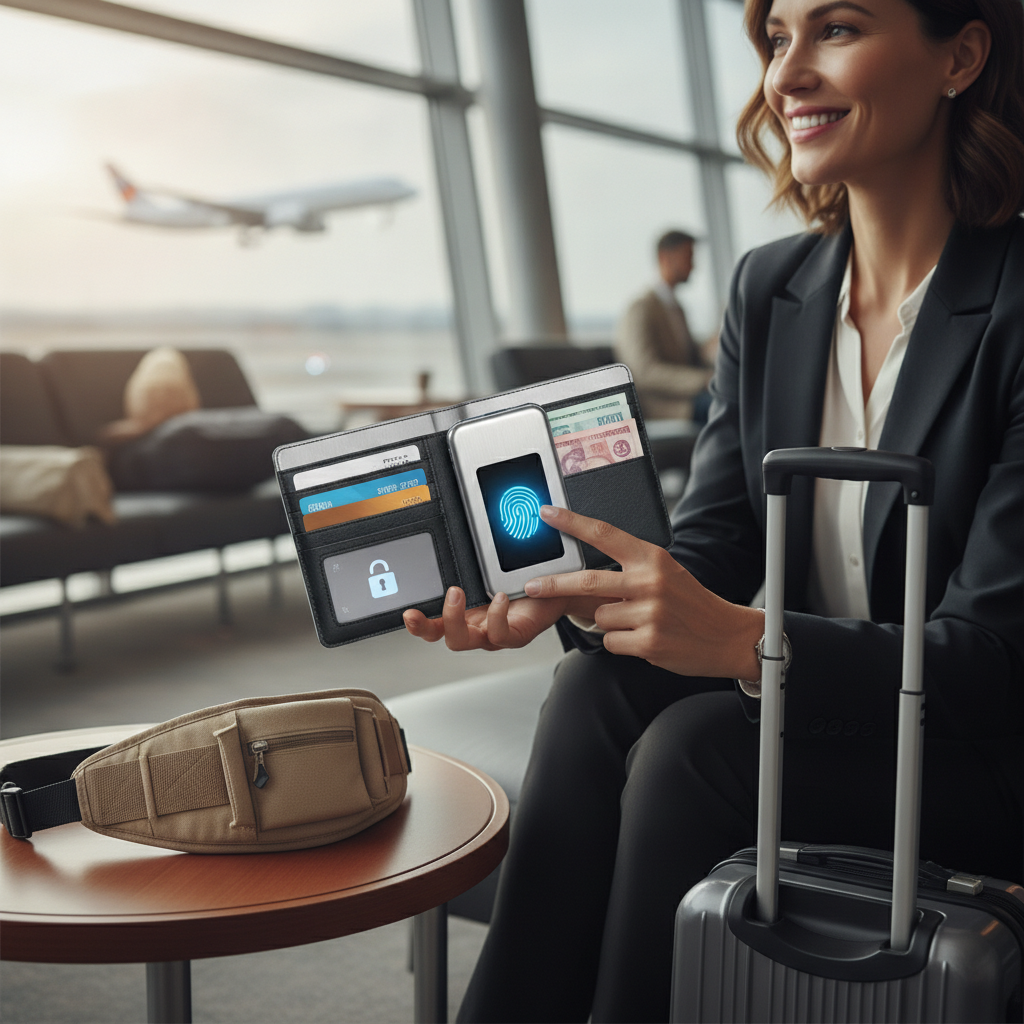
Pickpocketing has always been one of the more predictable hazards of international travel, and for decades, the money belt was the traveler's best answer. Tucked under clothing, bulky, and awkward to access, the money belt solved one problem while creating several others. Biometric smart wallets with fingerprint lock technology are now offering a more elegant alternative — one that's changing how security-conscious frequent flyers carry cash, cards, and documents on the road.
What Exactly Is a Biometric Smart Wallet?
A biometric smart wallet looks similar to a conventional slim wallet at first glance, but houses a small fingerprint scanner embedded in the outer casing. When a registered fingerprint is detected, the wallet either unlocks a hidden internal compartment or releases a secured card tray. Brands like Volterman, Ekster, and Walli have all developed versions of this concept, each with slightly different approaches to locking mechanisms and companion app integration. Some models connect via Bluetooth to a smartphone, allowing owners to trigger alerts if the wallet moves beyond a set distance — adding an extra recovery layer that a traditional money belt never offered.
How Does Fingerprint Technology Work at This Scale?
The fingerprint sensors used in smart wallets are miniaturized versions of the same capacitive scanning technology found in modern smartphones. A tiny sensor maps the unique ridge patterns of a registered fingertip and compares each scan to stored data in milliseconds. Most biometric wallets store fingerprint data locally on the device rather than in the cloud, which matters to privacy-minded travelers who are already cautious about their digital footprint. The scanning process typically works reliably even when fingers are slightly damp, though extreme conditions like wet markets or heavy rain can occasionally slow recognition. Manufacturers continue improving sensor sensitivity with each product generation.
Why Are Frequent Flyers Moving Away From Traditional Money Belts?
The money belt's core appeal was concealment, but that same quality made everyday transactions genuinely inconvenient. Pulling out a hidden belt in a crowded airport or market is awkward, slow, and occasionally draws more attention than it deflects. Frequent flyers — particularly those moving through multiple countries on short trips — need access to cards and currency that matches the speed of modern travel. A biometric wallet sits comfortably in a front pocket, opens with a touch, and keeps contents locked against opportunistic theft without requiring a wardrobe adjustment at every payment moment. For road warriors who might pass through three cities in a week, that kind of frictionless security matters.
What Features Matter Most When Choosing One?
Beyond the fingerprint lock itself, the most useful biometric wallets tend to include RFID-blocking layers that prevent wireless skimming of contactless cards — a genuine concern in transit hubs like Heathrow or Changi Airport. Battery life is another practical consideration, since a dead battery on a locking wallet creates a problem that no traditional wallet ever posed. Most models use small rechargeable cells that last several weeks on a single charge, and better designs include a manual override mechanism for low-battery situations. Travelers should also consider capacity: a wallet built for four cards and a folded note may not suit someone carrying multiple currencies and an international SIM card.
How Do These Wallets Perform in Real-World Travel Conditions?
Frequent flyers who've adopted biometric wallets generally report that the fingerprint recognition holds up well across climates, from the humidity of Southeast Asia to the dry cold of Scandinavian winters. The Bluetooth tracking features have proven genuinely useful in hotel rooms and airport lounges, where wallets are easily left on surfaces during distracted moments. One practical limitation worth noting is that border crossings and customs inspections occasionally require showing documents quickly, and fumbling with a fingerprint sensor under pressure can add minor friction. Travelers who anticipate frequent document checks sometimes carry a second slim traditional card holder for those moments, keeping their biometric wallet for higher-value items.
How Should You Integrate One Into Your Travel Setup?
If you're considering making the switch, start by identifying exactly what you carry on a typical travel day — cards, cash denomination mix, ID, SIM card — and choose a model sized for that specific load rather than maximum capacity. Register two or three fingers during setup, including a non-dominant hand option for crowded situations where reach is limited. Charge the wallet before every trip rather than on an as-needed basis, and download the companion app for whichever brand you choose before leaving home so location features are active from day one. Keep the wallet in a front trouser pocket or the outer pocket of a cross-body bag rather than a backpack, where it remains accessible without removing the bag entirely.
Biometric smart wallets represent a genuine shift in how travelers think about everyday security — moving away from concealment-based strategies toward access-controlled ones. The fingerprint lock brings smartphone-grade authentication to one of travel's most vulnerable touch points, and the addition of RFID blocking and Bluetooth tracking makes these devices meaningfully more capable than the money belts they're gradually displacing. For frequent flyers who value both convenience and protection, this category of travel tech has matured to the point where it's worth treating as standard kit rather than a novelty upgrade.